
Infrastructure Migration Services
Sphere provides IT migration services across cloud, data centers, VMware estates, applications, and data platforms—built around dependency visibility, secure landing zones, cutover discipline, and cost control.
Start Migration Assessment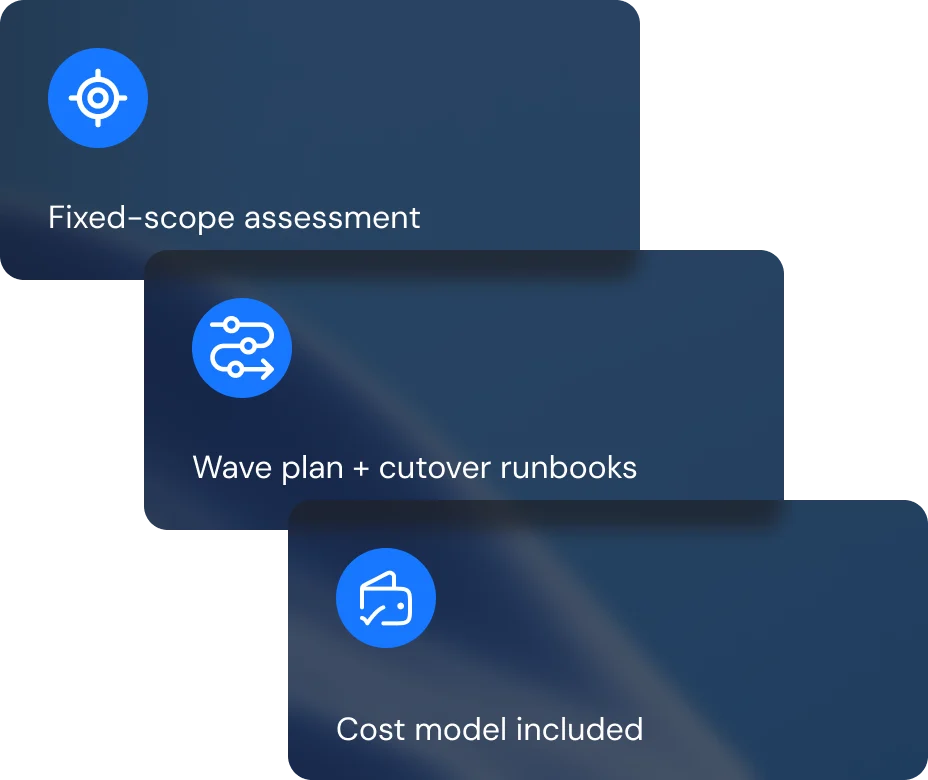
What teams come here to fix
Migration speed comes from removing rework before it starts. The items below are the most common sources of rework we see across real programs.
Hidden dependencies
Late discoveries change sequencing and create emergency work during cutovers. We map the systems and owners needed to plan waves that hold.
Landing zone gaps
Identity, network controls, logging, and policies decide whether workloads behave predictably after the move. We define the platform baseline as a deliverable.
Cutover uncertainty
Downtime windows need a runbook, validation steps, and a recovery plan your teams rehearse. We build cutover discipline into every wave.
Cost volatility
Run-rate changes after migration when sizing, storage tiers, and shared services are chosen on the fly. We attach a cost model to the wave plan.
IT Migration Services by cluster
Choose the cluster that matches your current pressure point. Sphere runs migrations as a program: portfolio inventory, dependency mapping, landing zone readiness, wave execution, and stabilization.

Cloud migration services
Cloud adoption runs cleanly when identity, policy, logging, and ops ownership are designed early.
Includes:
- landing zone control points
- workload patterns
- stabilization plan
Common paths:
- landing zone control points
- workload patterns
- stabilization plan


Cloud-to-cloud migration
Tenant and platform moves stay stable when security and operational tooling are aligned early.
Includes:
- identity alignment
- networking plan
- cutover readiness
Common paths:
- AWS → Azure
- Azure → AWS
- Heroku → AWS


VMware migration services
VMware estates migrate through grouped waves aligned to workload risk and platform direction.
Includes:
- application grouping
- migration patterns per group
- execution playbooks
Common paths:
- vSphere/VCF → Cloud
- vSphere → alternative virtualization
- vSphere → Kubernetes platform


Data migration services
Databases and analytics platforms move with reconciliation, validation, and controlled cutovers.
Includes:
- transfer approach
- data checks
- cutover sequencing
Common paths:
- Teradata → Snowflake
- Netezza → Snowflake
- Redshift → BigQuery
- Hadoop → Snowflake


Application migration services
Application portfolios migrate as a program with sequencing based on dependencies and release cycles.
Includes:
- portfolio triage
- wave plan
- test gates and validation
Common paths:
- Shopify → WooCommerce
- WordPress → Webflow
- Wix → WordPress


De-Risk Your Migration Before You Move
What you get from Sphere
Sphere turns migration planning into execution-ready assets your teams can run. You get a clear inventory, a dependency-informed wave plan, a destination baseline that security and ops can operate, and cutover runbooks with validation steps. The output is designed to reduce rework during delivery and keep scope, risk, and cost visible wave by wave.
A migration program your teams can execute

Step 1: Assess (2–3 weeks)
Scope, inventory, risks, target architecture, and wave plan. Cost model and delivery ranges tied to the same plan.

Step 2: Foundation
Landing zone build, security baseline, identity patterns, and observability. Tooling and access model prepared for wave execution.

Step 3: Waves
Wave-by-wave migrations with runbooks and validation gates. Stabilization support tied to owners and operating hours.

Step 4: Optimize
Performance tuning and cost optimization backlog. Operational handoff and ongoing platform governance.
Migration Delivery Pods
Migration delivery needs a stable core team that can hold design intent through execution. Sphere pods include infrastructure and cloud architects, migration engineers, data engineers, security engineering, QA automation, and a cutover lead coordinating runbooks and go-live readiness. The pod works in weekly milestones tied to waves and releases, with executive visibility that stays grounded in concrete deliverables: readiness decisions, cutover dates, and risk status.

Pod roles include
Infrastructure/Cloud Architects, Migration Engineers, Data Engineers, Security Engineering, QA & Automation, Cutover Lead, Ops Enablement

Cadence
Weekly milestone review, risk register updates, wave readiness checkpoints
Customer Stories
Explore Out MoreHear from Our Clients

TOP AI CODE Generation COMPANY UNITED STATES 2025

TOP AI TEXT Generation COMPANY florida 2025

TOP APP development COMPANY manufacturing 2025

TOP artificial intelligence COMPANY united states 2025

TOP chatbot COMPANY united states 2025
TOP recommendation systems COMPANY united states 2025
Sphere in Numbers
We understand that actions speak louder than words and numbers but here are some key facts about us.
Get the Right Talent now0
Years of Excellence
0+
Projects Delivered
0
Countries
Globally diverse, community-focused
0+
Clients
top 20 average 8+ years
Bring your scope.
Start your Migration Assessment.


Flexible, fast, and focused — Sphere solves your tech and business challenges as you scale.
Luke Suneja
Client Partner
Talk to a Sphere expert
Please provide your contact details, and our team will get back to you promptly.