
NetSuite–Salesforce Integration
Integrate Salesforce with NetSuite ERP to run quote-to-cash as one flow: accounts, products, pricing, orders, invoices, and renewals. Fixed-scope Salesforce–NetSuite integration for RevOps, finance, and order management teams.
Start Integration
When NetSuite–Salesforce Integration Matters
A Salesforce–NetSuite integration becomes a priority when sales confidence and finance confidence stop matching. Quotes look right in Salesforce. The downstream record in NetSuite tells a different story. The symptoms vary by company.
Discount logic, billing terms, tax handling, and item structure live in NetSuite. Sales teams work from Salesforce fields that drift over time, and approval paths become inconsistent across deal sizes and customer types.
Ops teams turn closed-won deals into manual handoffs: recreating sales orders, rebuilding line items, fixing ship-to / bill-to fields, and correcting missing entity details.
Accounts and items get created twice, naming diverges, and the “real” customer profile becomes unclear across CRM and ERP. Reporting turns into reconciliation.
Fulfillment moves in NetSuite. Sales stays blind to backorders, partial shipments, and delivery timelines. Customer conversations degrade into “let me check with ops.”
Orders get blocked in ERP. Sales learns late. Collections and delivery coordination turn into reactive work.
Subsidiaries, base currencies, and entity boundaries shape approvals, pricing, and record authority. The integration needs to respect that structure on every transaction.
Run quote-to-cash as one system
Sphere connects Salesforce to NetSuite so a deal in Salesforce becomes a controlled NetSuite transaction. We align roles, approvals, subsidiaries, currencies, items, and financial rules so quotes, orders, invoices, and payments follow one set of rules end-to-end.
Stop stitching systems manually — integrate NetSuite with clarity and ownership.
What Sphere builds between NetSuite and Salesforce
Single source of truth
We define which system owns each record and field, and we stop duplicates.
Quote → Order automation
Convert Salesforce quotes into NetSuite sales orders with the right line items and terms.
Approvals and controls
We implement approval rules by amount, role, entity, and customer type.
Order status back to Salesforce
Sync fulfillment, invoice, payment, and hold status so sales stays informed.
Billing and renewals readiness
We align contract terms and billing schedules so invoicing and renewals don’t break later.
OneWorld support
We route transactions by subsidiary, currency, and permissions so multi-entity setups work.
How NetSuite and Salesforce stay aligned
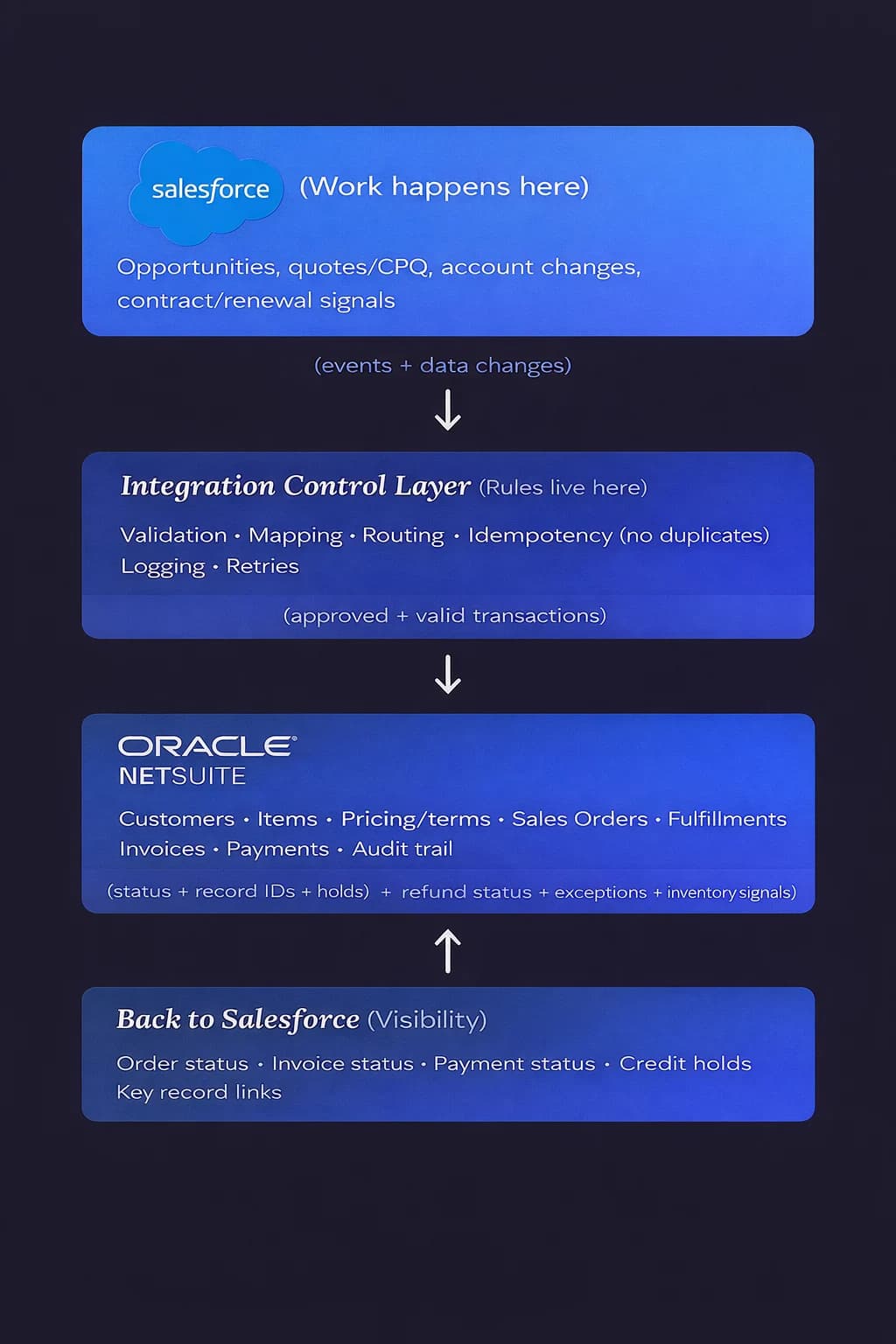
Salesforce captures the commercial process – opportunities, quotes, account changes, and contract or renewal signals – while NetSuite manages the operational and financial execution behind those deals. Sphere connects the two through a controlled integration layer that validates incoming updates, maps CRM structures to NetSuite records, and routes transactions according to entity and pricing rules. Idempotency and logging ensure records are created only once and every transaction remains traceable.
Once orders move through NetSuite, key signals – order status, invoice state, payment progress, credit holds, and record identifiers – flow back to Salesforce. Sales and account teams gain real visibility into what is happening after the deal closes, while NetSuite remains the authoritative system for customers, pricing, fulfillment, invoicing, and financial reporting.
How this integration is delivered

Phase 1 — Integration Assessment
2–3 weeks. Fixed price. Defines scope, flows, and complexity tier.

Phase 2 — Implementation
Fixed-price range based on complexity. Accelerator-based delivery.

Phase 3 — Managed Integration
Monthly support, optimization, and new workflows.
You buy the integration. The assessment defines how it will be built and priced.
Start IntegrationCustomer Stories
Explore Out MoreHear from Our Clients

Top AI Code Generation Company United States 2025

Top AI Text Generation Company Florida 2025

Top App Development Company Manufacturing 2025

Top Artificial Intelligence Company United States 2025

Top Chatbot Company United States 2025
Top Recommendation Systems Company United States 2025
Sphere in Numbers
We understand that actions speak louder than words and numbers but here are some key facts about us.
Get the Right Talent now0
Years of Excellence
0+
Projects Delivered
0
Countries
Globally diverse, community-focused
0+
Clients
top 20 average 8+ years
Clear scope. Predictable cost. No open-ended builds.
Please provide your contact details, and our team will get back to you promptly.