
NetSuite–Shopify Integration
Connect Shopify with NetSuite so every ecommerce order moves straight into your ERP. Inventory stays accurate across locations, and fulfillment, cancellations, refunds, and customer updates follow the same order record from purchase to completion.
Start Integration
When NetSuite–Shopify Integration Matters
A NetSuite–Shopify integration becomes essential when Shopify drives sales and NetSuite drives operational and financial control. The store keeps moving. Teams start chasing orders, stock, and refund details across multiple views.
A customer checks out in Shopify. The team still needs that order represented correctly in NetSuite with the right customer, item mapping, taxes, shipping details, and transaction status.
Shopify tracks inventory by location and state. NetSuite manages item and fulfillment logic through its own inventory and order flow. A mismatch in location mapping or timing creates oversell risk, delayed fulfillment, and manual corrections.
Order creation happens in Shopify. Pick, pack, ship, backorder handling, and fulfillment progression may happen across NetSuite, warehouse processes, and shipping tools. Customer service needs one current view.
Refunds, exchanges, shipping refunds, and restocking decisions change both customer experience and financial records. A delay between Shopify activity and NetSuite recognition creates cleanup work for customer service and finance.
Discounts, shipping methods, gift cards, taxes, bundles, item identifiers, and payment-related details need a clean translation into NetSuite’s record model.
Order totals, refunds, cancellations, fulfillment timing, and inventory movement all affect the finance view. The closer those events stay to NetSuite in real time, the cleaner the reporting cycle becomes.
Run the full ecommerce order lifecycle with Shopify and NetSuite in step
Sphere connects Shopify to NetSuite so orders, customers, inventory signals, fulfillment updates, and refund activity move through one governed flow. Our team handles SKU mapping, location logic, tax and shipping translation, order routing, refund processing, and exception handling so ecommerce teams keep momentum and finance keeps reliable records.
Stop stitching systems manually — integrate NetSuite with clarity and ownership.
NetSuite and Shopify
Order and customer sync
Shopify orders and customers move into NetSuite with the right identifiers, item mappings, taxes, shipping details, and order structure.
Inventory and location alignment
Sphere maps Shopify locations and inventory signals to NetSuite item and fulfillment logic so stock visibility supports real selling and shipping decisions.
Fulfillment status flow
Shipment progress, fulfillment status, and key order updates return to the systems and teams that need them, giving ecommerce and service teams current order visibility.
Cancellations, refunds, and returns
Refunds, exchanges, shipping refunds, restocking outcomes, and return-related events can move into NetSuite with the right financial and inventory treatment.
Promotion and pricing logic
Discounts, gift-card related flows, and order-level commercial details are mapped deliberately so downstream records stay usable.
Exception handling
SKU mismatches, order import failures, missing mappings, duplicate risks, and refund edge cases move into a managed flow with logging and ownership.
How NetSuite and Shopify stay aligned
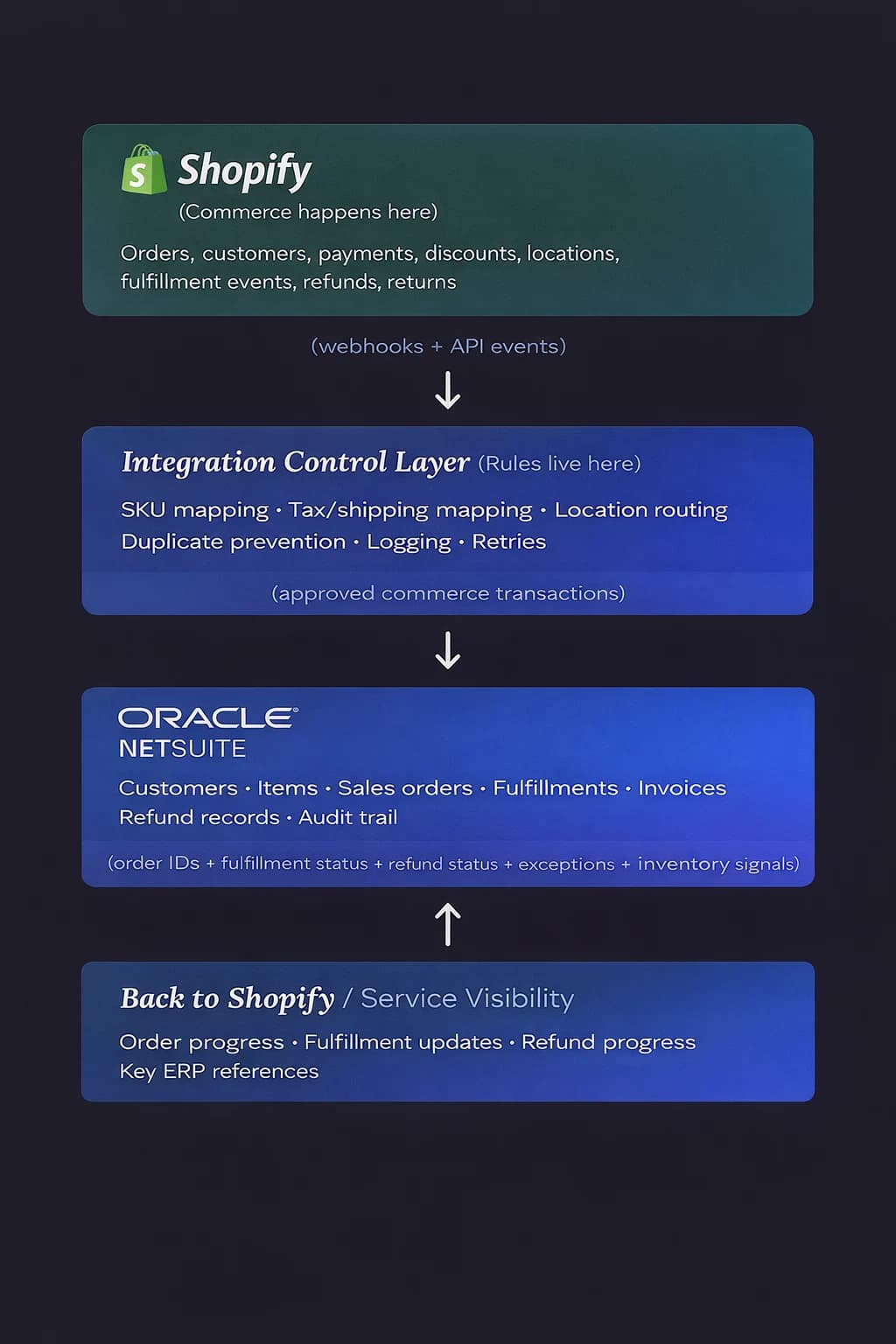
Shopify captures the commerce activity – orders, payments, discounts, fulfillment updates, and refunds – as it happens in the storefront. NetSuite maintains the authoritative operational and financial records behind those transactions. Sphere connects the two through a controlled integration layer that maps SKUs, routes transactions to the correct locations, aligns tax and shipping structures, and prevents duplicates before records reach NetSuite.
Once transactions are processed, NetSuite sends back key operational signals such as order IDs, fulfillment status, refund outcomes, and exception states. This keeps Shopify teams and service operations informed about real order progress while NetSuite retains full control over accounting, inventory, and auditability.
How this integration is delivered

Phase 1 — Integration Assessment
2–3 weeks. Fixed price. Defines scope, flows, and complexity tier.

Phase 2 — Implementation
Fixed-price range based on complexity. Accelerator-based delivery.

Phase 3 — Managed Integration
Monthly support, optimization, and new workflows.
You buy the integration. The assessment defines how it will be built and priced.
Start IntegrationHear from Our Clients

TOP AI CODE Generation COMPANY UNITED STATES 2025

TOP AI TEXT Generation COMPANY florida 2025

TOP APP development COMPANY manufacturing 2025

TOP artificial intelligence COMPANY united states 2025

TOP chatbot COMPANY united states 2025

TOP recommendation systems COMPANY united states 2025
Sphere in Numbers
We understand that actions speak louder than words and numbers but here are some key facts about us.
Get the Right Talent now0
Years of Excellence
0+
Projects Delivered
0
Countries
Globally diverse, community-focused
0+
Clients
top 20 average 8+ years
Clear scope. Predictable cost. No open-ended builds.


Flexible, fast, and focused — Sphere solves your tech and business challenges as you scale.
Luke Suneja
Client Partner
Get Started with NetSuite – Shopify Integration
Please provide your contact details, and our team will get back to you promptly.