Author
Dmytro Shein
Solution Architect
With over two decades in IT, Dmytro has indeed thrived on financial projects.
Dmytro began with Deutsche Telecom’s billing system, delved into payday loans at Enova, and contributed to a major European forex company. Presently, Dmytro is working on BP projects, focusing on intricate pricing and fee calculation, consistently earning high praise from employers.
32 posts by this author

Vertical Twins as Seed Packs: Starting at Mile Ten, Not Mile Zero
Every organization in an industry shares a lot of structure. A vertical twin captures that shared structure as a starting point — data and configuration, not a new engine — so you begin modeling at mile ten instead of a blank canvas.
Read the article
A Twin That Updates Itself: Modeling on a Live Change Stream
A model of your organization that's accurate the day you build it and wrong a month later is worse than useless. An Enterprise Twin avoids that by projecting from a live change stream, so it reflects the organization as it is now.
Read the article
Key-Person Risk, Measured: Finding the Single Points of Failure in Your Org
Every organization has people it can't afford to lose, and most only find out who when they leave. Modeled as centrality on an organizational graph, key-person risk becomes something you can measure and act on in advance.
Read the article
Scoring AI-Readiness 0-100: Where Automation Actually Pays
'Where should we use AI?' is usually answered by a vendor survey and a hunch. An AI-readiness score answers it with a comparable number per process, built from the factors that actually determine whether automation will work.
Read the article
The Opportunity Map: Turning an Org Model into a Build Backlog
An AI strategy deck is where good intentions go to die. An opportunity map is different: a ranked backlog of where automation delivers the most value against the least risk, drawn from a model of how your organization actually works.
Read the article
Your Enterprise Needs an API for Agents, Not Just for Humans
For thirty years your systems served one kind of client: a person at a screen. Now a second client has arrived — AI agents — and they need a governed way in. That's what an agent-facing interface, built on the Model Context Protocol, provides.
Read the article
A Tool Registry for Enterprise Agents: A Few Tools, One Front Door
An AI agent is only as capable — and as safe — as the tools it's allowed to call. A tool registry defines those tools explicitly: a governed, declared set of operations agents can discover and use, behind one front door.
Read the article
Authorizing an Agent: Letting AI Act on Your Systems, Safely
An agent that only reads is useful; an agent that can act is transformative — and dangerous. Authorizing an agent means letting it take actions on your systems under strict permissions, human approval for the irreversible, and a full record.
Read the article
Source of Truth, Not Source of Leaks: Governing What AI Is Allowed to Read
An AI assistant pointed at your company knowledge is either your best source of truth or your worst source of leaks, and the deciding factor is one thing: whether you govern what it's allowed to read. Access governance is the precondition, not the polish.
Read the article
ACLs That Survive a Resync: Keeping Connector Permissions Correct
The hard part of permission-aware AI isn't checking access once — it's keeping the source system's permissions correct as connectors re-sync. A naive integration can quietly turn a restricted document into an open one.
Read the article
Connecting Slack, SharePoint, Salesforce, and Drive Without Leaking Scope
Connecting your AI to every system of record is where enterprise value lives — and where governance most often breaks. Governed ingestion means pulling content from Slack, SharePoint, Salesforce, and Drive while carrying each source's permissions with it.
Read the article
The Over-Sharing Trap in Enterprise Search, and How to Close It
An AI assistant is a confused deputy: it acts with more access than any single user should have. Point it at your documents without per-user permission enforcement and it becomes an over-sharing engine. Here's the trap, and how to close it.
Read the article
BYOK, Properly: Bring-Your-Own-Key Across Every Model in One Boundary
Bring-your-own-key is often a checkbox that means little. Done properly, it means your keys stay in your custody, work across every model provider, and never make any single vendor the place your data or your leverage lives.
Read the article
Self-Hosted vs API-Only AI: A Real Cost and Control Comparison
API-only AI is faster to start; self-hosted gives you control you may be required to have. This is the honest comparison — on cost, control, compliance, and continuity — without pretending one answer fits everyone.
Read the article
A Publish Gate for Prompts: Version, Test, and Roll Back a System Prompt
A system prompt is code that shapes every answer an agent gives — yet it's usually edited live, untested, with no history. Treating prompts like code, behind a publish gate, ends the era of quietly breaking an agent with a one-line tweak.
Read the article
Verification You Can Watch: Replaying Exactly What the Judge Saw
A pass/fail verdict you can't inspect is just another opaque score. Verification you can watch lets you replay exactly what the check saw and why it ruled — so you trust the gate, and can fix what it flags.
Read the article
Golden Sets That Do Not Rot: Building a Test Suite for an AI Agent
A golden set is an AI agent's exam — known questions with known-correct answers. Its whole value is in the curation and the upkeep. Here's how to build one that actually measures quality, and keep it from quietly going stale.
Read the article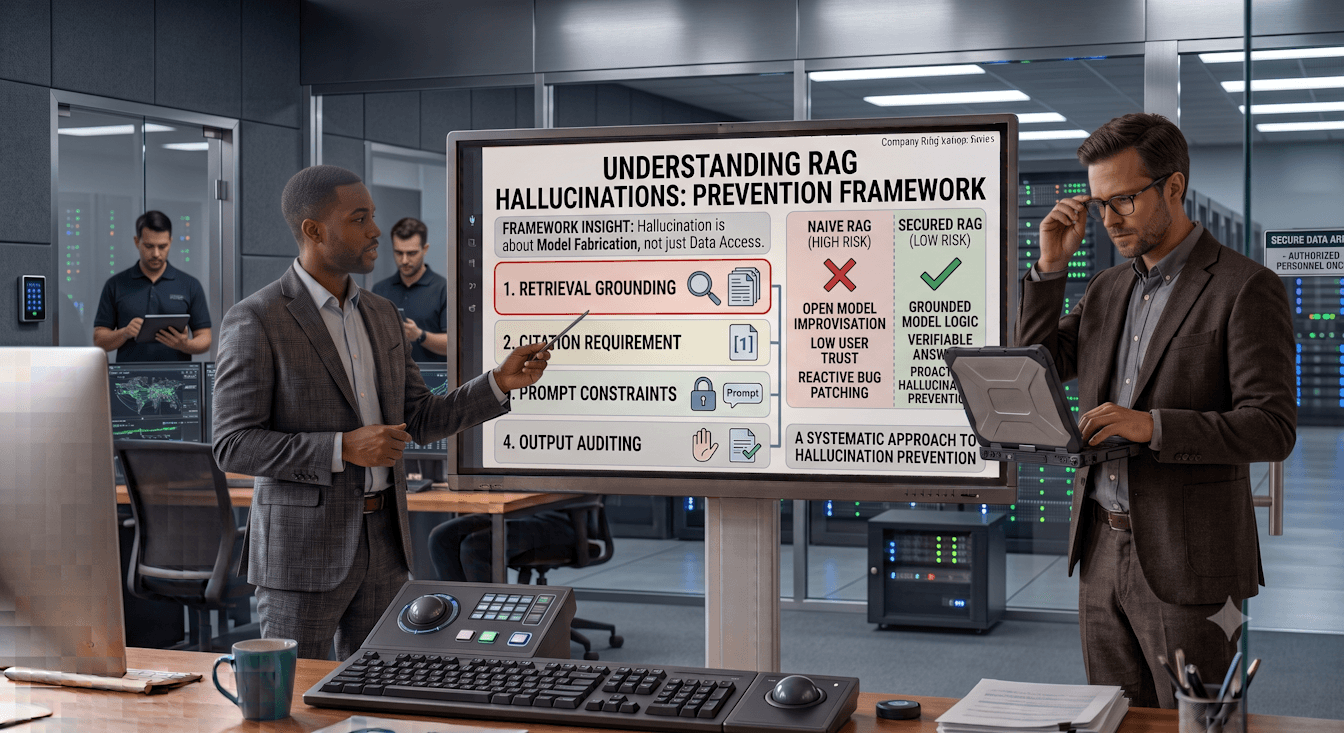
RAG Hallucination: Why It Happens in Enterprise Systems and How to Prevent It
RAG reduces hallucination — it doesn't eliminate it. When a production system fabricates, the culprit is almost always upstream: the answer-bearing passage was never retrieved, the index served a stale version, or the prompt let the model improvise. Here's the diagnostic that traces a wrong answer back to its layer, and the prevention stack — retrieval, freshness, prompting, no-answer behavior, red-teaming — that stops it recurring.
Read the article
Column-Level Encryption for AI Data: Sealing What the Model Touches
Full-disk encryption is table stakes and also nearly useless against the threats that actually matter — it protects against a physically stolen drive and does nothing once the database is mounted and readable. For the sensitive fields an AI system stores, you want something stronger: encryption at the level of the individual column, so the value is sealed even from someone with broad access to the store.
Read the article
Small, Composable, and Boring: A Better Architecture for Enterprise Software
A few months ago, a few of us on the architecture team were in a fairly ordinary meeting, comparing notes on why our internal tooling roadmap kept getting derailed by the "next big platform migration." Someone said out loud what most of us had been quietly thinking for years: the giant, do-everything products we keep buying are part of the problem, not the solution. What follows is a case, built over years of watching the same pattern repeat, for why smaller, focused, API-connected systems consistently outperform monolithic platforms in real organizations.
Read the article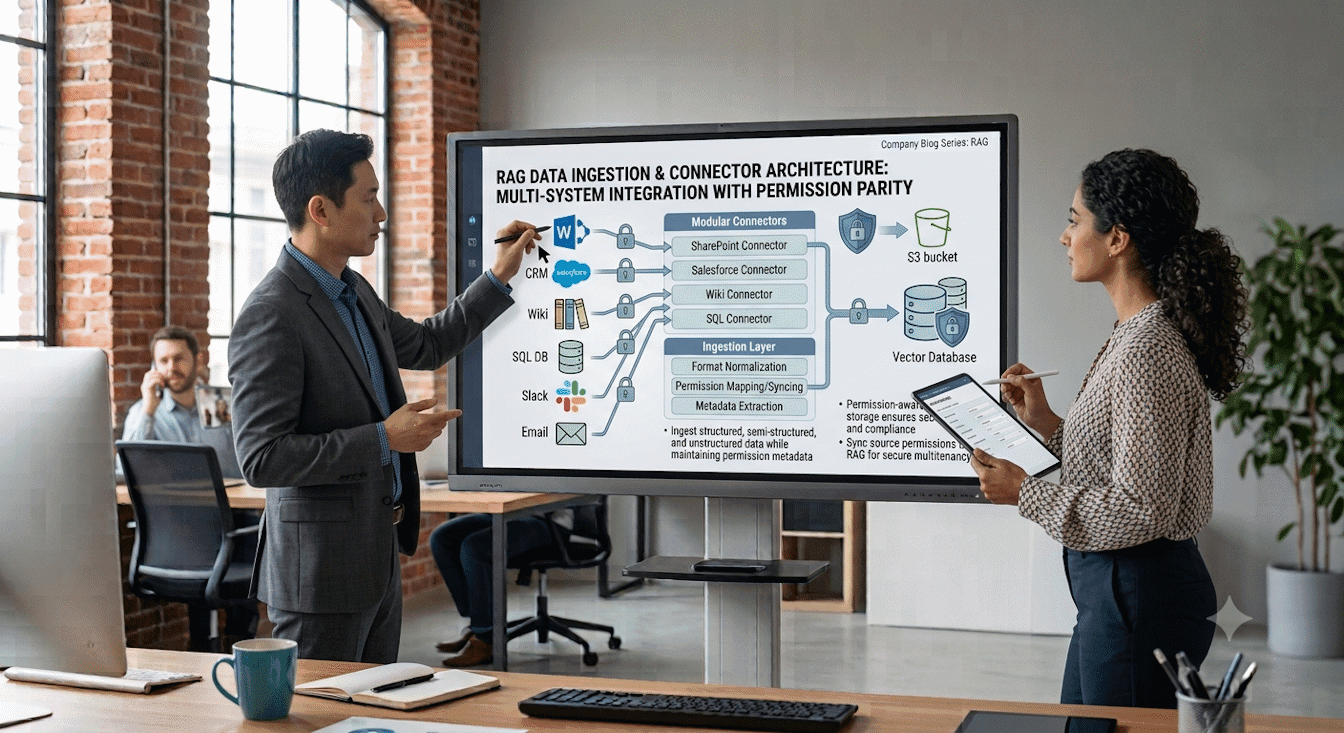
RAG Data Ingestion: Connecting Enterprise Systems Without Breaking Security
RAG projects don't die at the model or the vector database — they die quietly in the ingestion layer. Here's how to architect connectors, permission inheritance, format handling, and incremental refresh so enterprise knowledge reaches the index without losing permissions, mangling formats, or going stale.
Read the article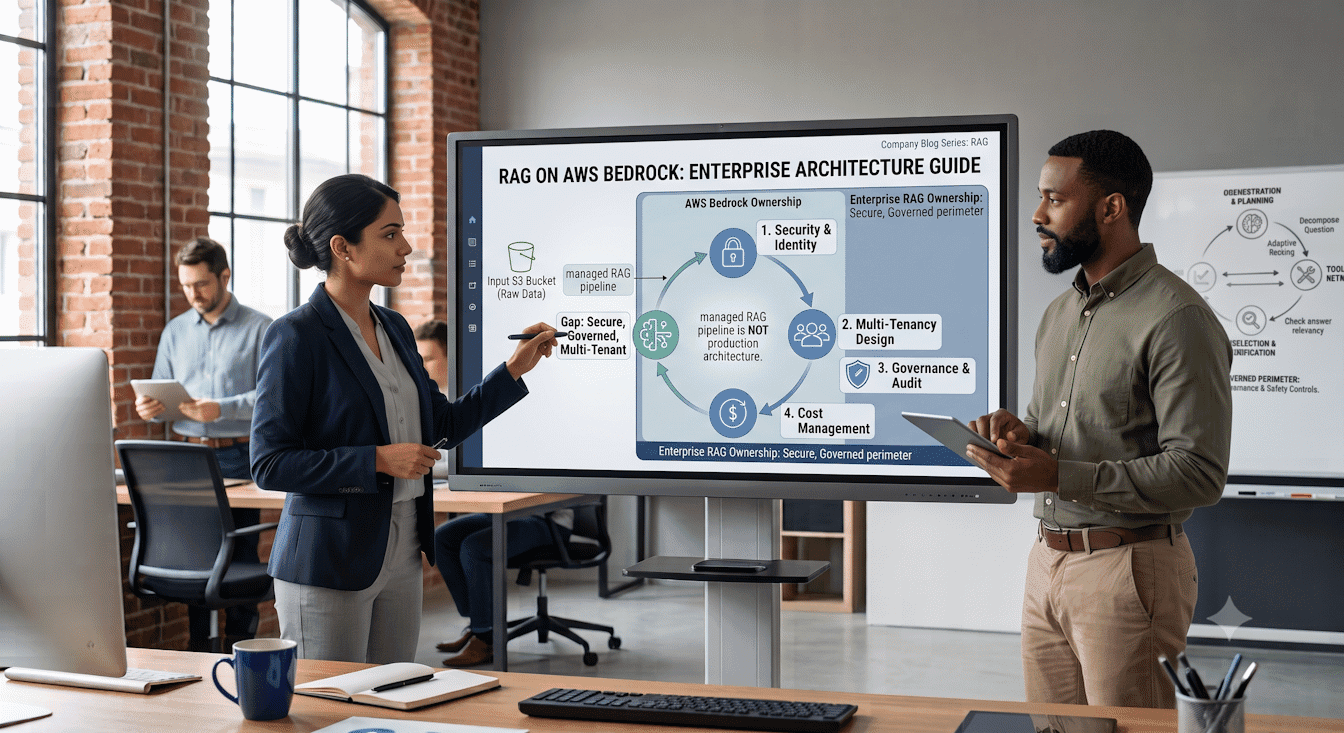
RAG on AWS Bedrock: Architecture Guide for Enterprise Teams
Bedrock Knowledge Bases manages chunking, embedding, vector storage, and retrieval for you — but not the connectors, multi-tenant IAM, model routing, and cost governance that separate a demo from production. Here are the four architecture calls that make Bedrock RAG enterprise-grade.
Read the article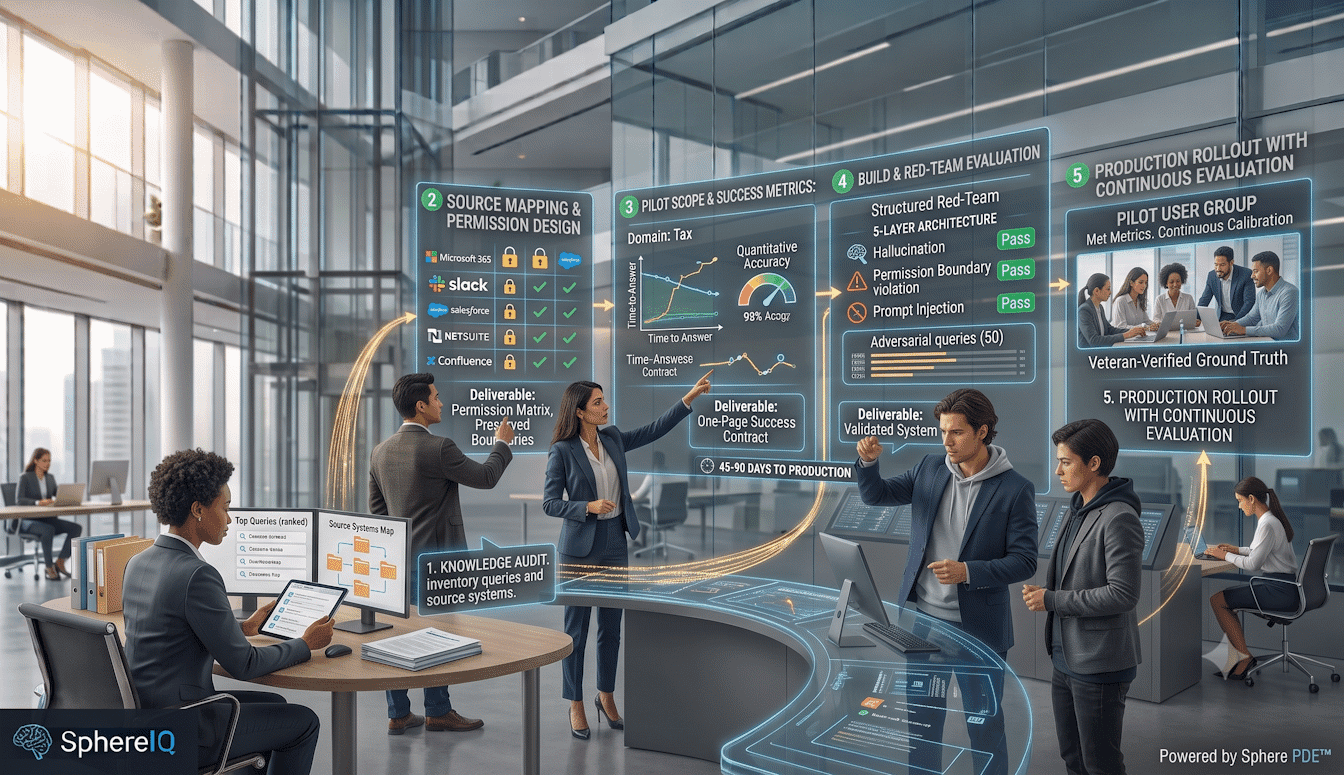
How to Build a Company Brain: A Step-by-Step Guide for Enterprise Leaders
Leaders do not need to rip out their existing systems to build a Company Brain. A focused knowledge audit, a source-system map, a defensible permission model, agreed success metrics, and a scoped rollout plan — and a production-grade deployment reaches employees in 45 to 90 days through Sphere's PDE™ delivery model.
Read the article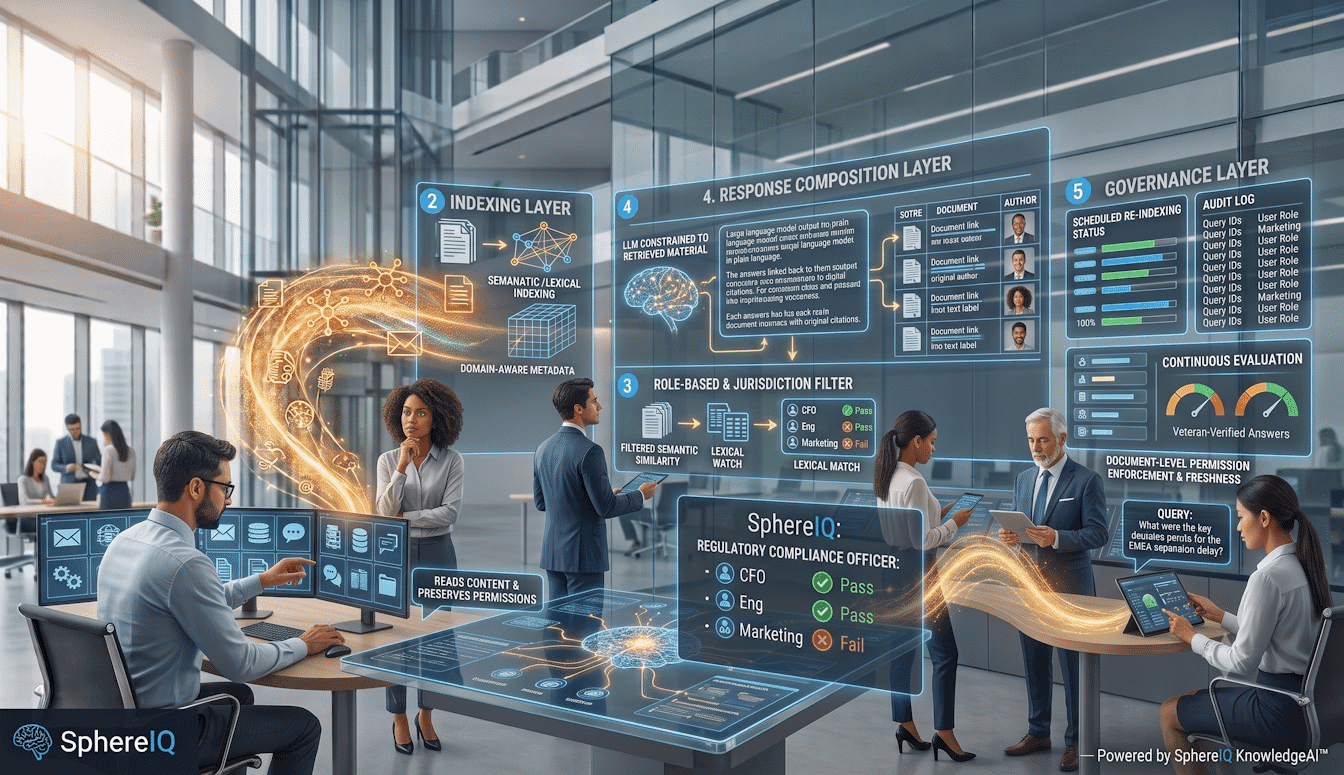
How a Company Brain Works: The Technology Behind Organizational AI Memory
A Company Brain connects to the systems where institutional knowledge already lives, indexes that knowledge by meaning rather than by filename, and returns sourced answers with the company's permission boundaries intact. The architecture is the same five-layer pattern Sphere has shipped into production — this article walks through each layer with the operating evidence attached.
Read the article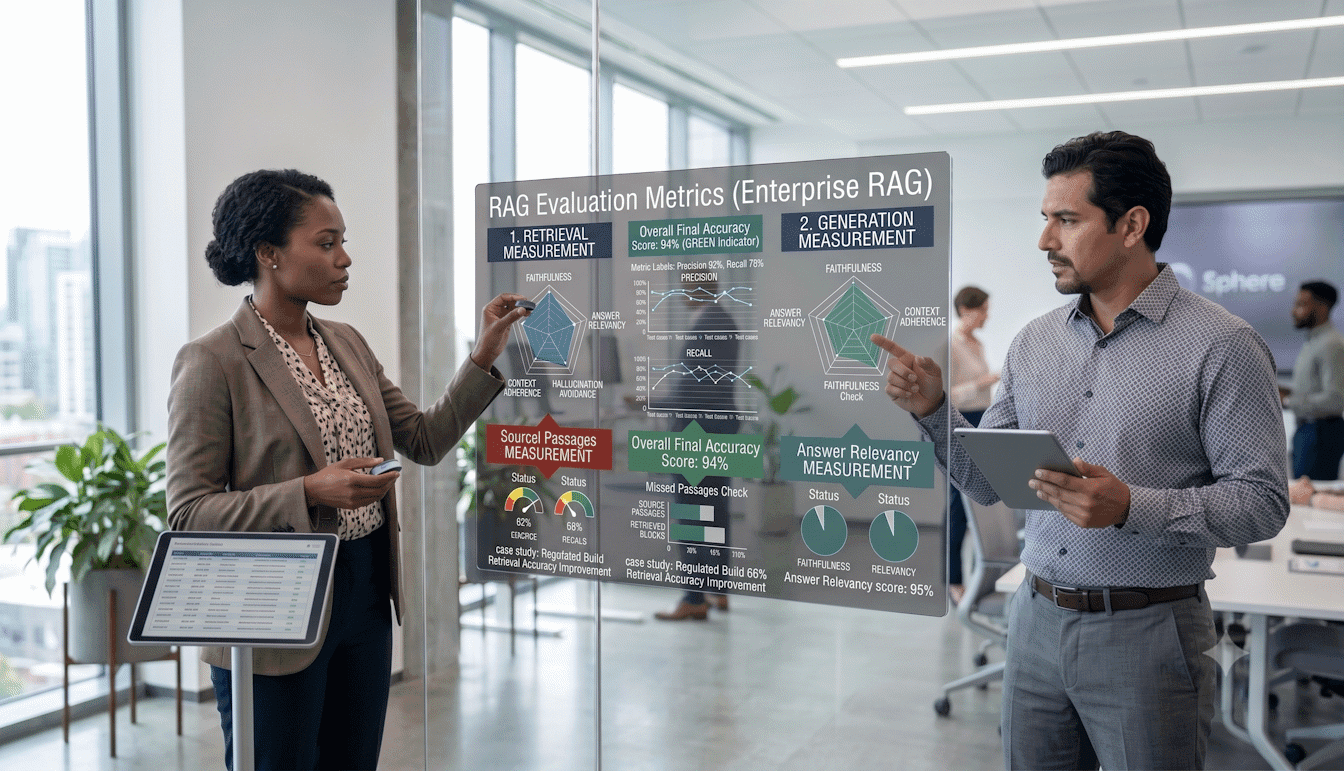
RAG Evaluation: How to Measure Accuracy Before Going to Production
Most enterprise RAG projects are evaluated on vibes. Four metrics split by layer — context precision, context recall, faithfulness, answer relevance — turn accuracy from an opinion into a number you can track, defend, and improve before and after production.
Read the article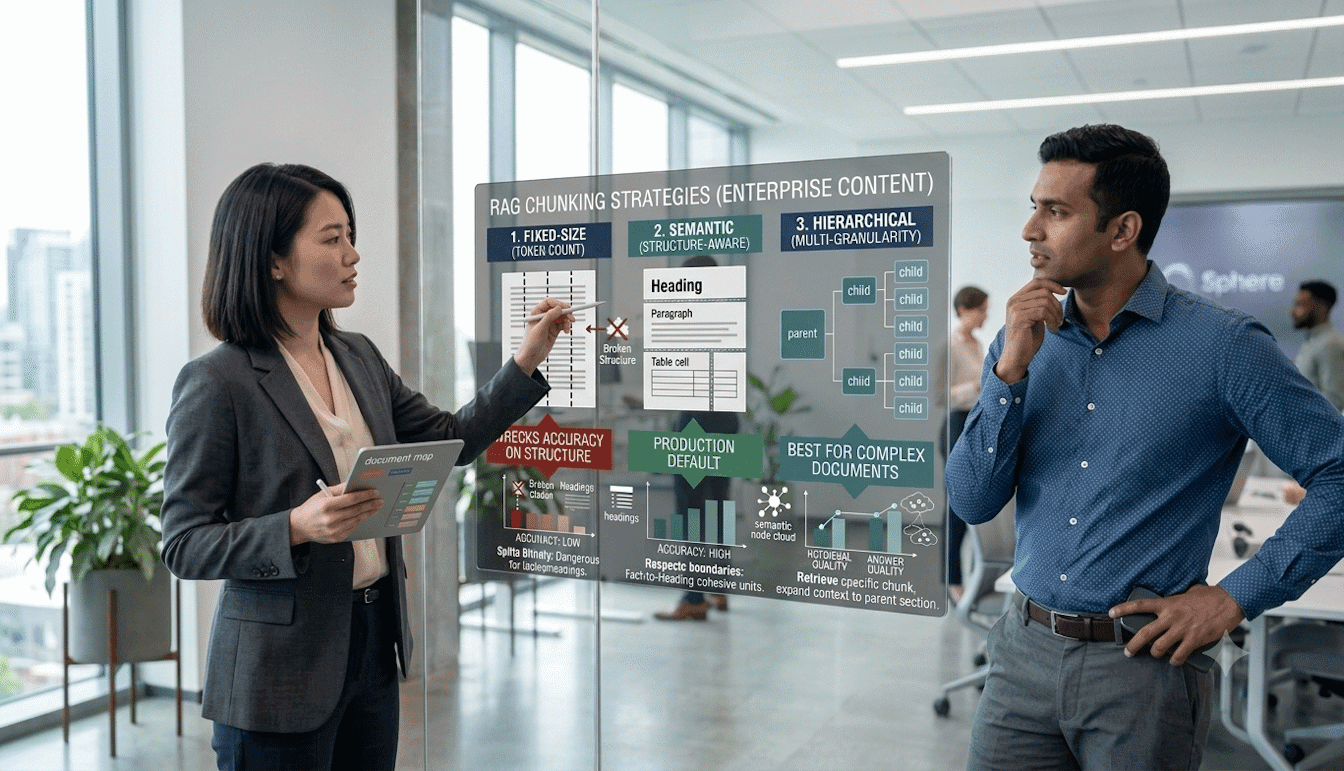
RAG Chunking Strategies: How to Split Documents Without Destroying Context
The least glamorous decision in RAG is the one that quietly determines retrieval quality: how you split documents. Fixed-size chunking cuts blind through structure. Semantic and hierarchical chunking preserve context — and chunk metadata is what makes citations, permissions, and filtering possible.
Read the article
Hybrid Search in Enterprise RAG: Why Vector-Only Is Leaving Accuracy on the Table
Vector-only retrieval quietly fails on the exact-match queries enterprise users depend on. Hybrid search — BM25 + vector retrieval fused with reciprocal-rank fusion and a reranking step — is the production baseline that makes enterprise RAG reliable.
Read the article
Multi-Model Enterprise AI: Why Model Flexibility Is a Governance Requirement, Not a Feature
Locking enterprise AI to a single vendor's model is not a commercial preference — it is a governance failure. Commercial risk, data residency constraints, model quality evolution, and regulatory exposure all require the ability to switch or add models without rebuilding your compliance layer.
Read the article
AI in Financial Services: What FINRA, MiFID II, DORA, and the EU AI Act Require
Financial services organisations face more AI-specific regulation than any other sector. Seven frameworks, applied simultaneously, to the same employees on the same platform. Here is what each requires, where they overlap, and how to enforce all of them without a separate compliance programme for each one.
Read the article
CSRD AI Emissions Reporting: A Practical Step-by-Step Guide for Sustainability Teams
You need to report the carbon footprint of your organisation's AI usage under ESRS E1. Your AI vendors provide none of the data. Here is exactly how to gather it, calculate it, and produce an auditable disclosure — with or without automated tracking.
Read the article
EU AI Act Risk Classification: A Step-by-Step Guide for Compliance Teams
How to classify every AI system your organisation uses across all five risk levels — the questions to ask, the eight Annex III domains that determine High-Risk status, fine thresholds at each tier, and what each classification requires you to do next.
Read the article