


Classify AI systems and generate compliance evidence in one guided flow.
Comply AI helps teams classify AI systems against EU AI Act risk categories, generate conformity checklists, and maintain a living compliance record across the organisation.
The compliance window is closing.
Every AI system needs to be identified, classified, documented, and monitored. For high-risk systems, teams also need conformity evidence, human oversight, record-keeping, and a defensible gap analysis.
Classification is unclear
Teams need to know whether a system is prohibited, high-risk, limited risk, or subject to GPAI obligations.
Documentation is manual
Legal and compliance teams spend days turning scattered system details into reviewable evidence.
Records go stale
AI systems change over time. Purpose, data, model, and deployment updates can shift compliance obligations.
Leadership needs proof
Audit committees and regulators need structured evidence, not scattered notes and disconnected spreadsheets.
Four steps from system description to compliance checklist.
The goal is to turn the first pass of AI compliance work into a guided flow that legal, compliance, and system owners can review together.
System intake
Describe the AI system in plain language. Comply AI extracts the relevant attributes: data type, decision domain, affected users, and deployment context.
Article 5 screening
Screen against prohibited practices such as social scoring, certain biometric use cases, and other unacceptable-risk categories.
Annex I + Annex III mapping
Map product-safety legislation and standalone high-risk categories, then cite the relevant overlap where applicable.
Conformity checklist
Generate obligations for risk management, data governance, documentation, record-keeping, transparency, oversight, robustness, and cybersecurity.
From intake to audit-ready evidence.
Comply AI gives legal, compliance, and system owners a guided way to classify AI systems, understand obligations, document gaps, and maintain proof over time.
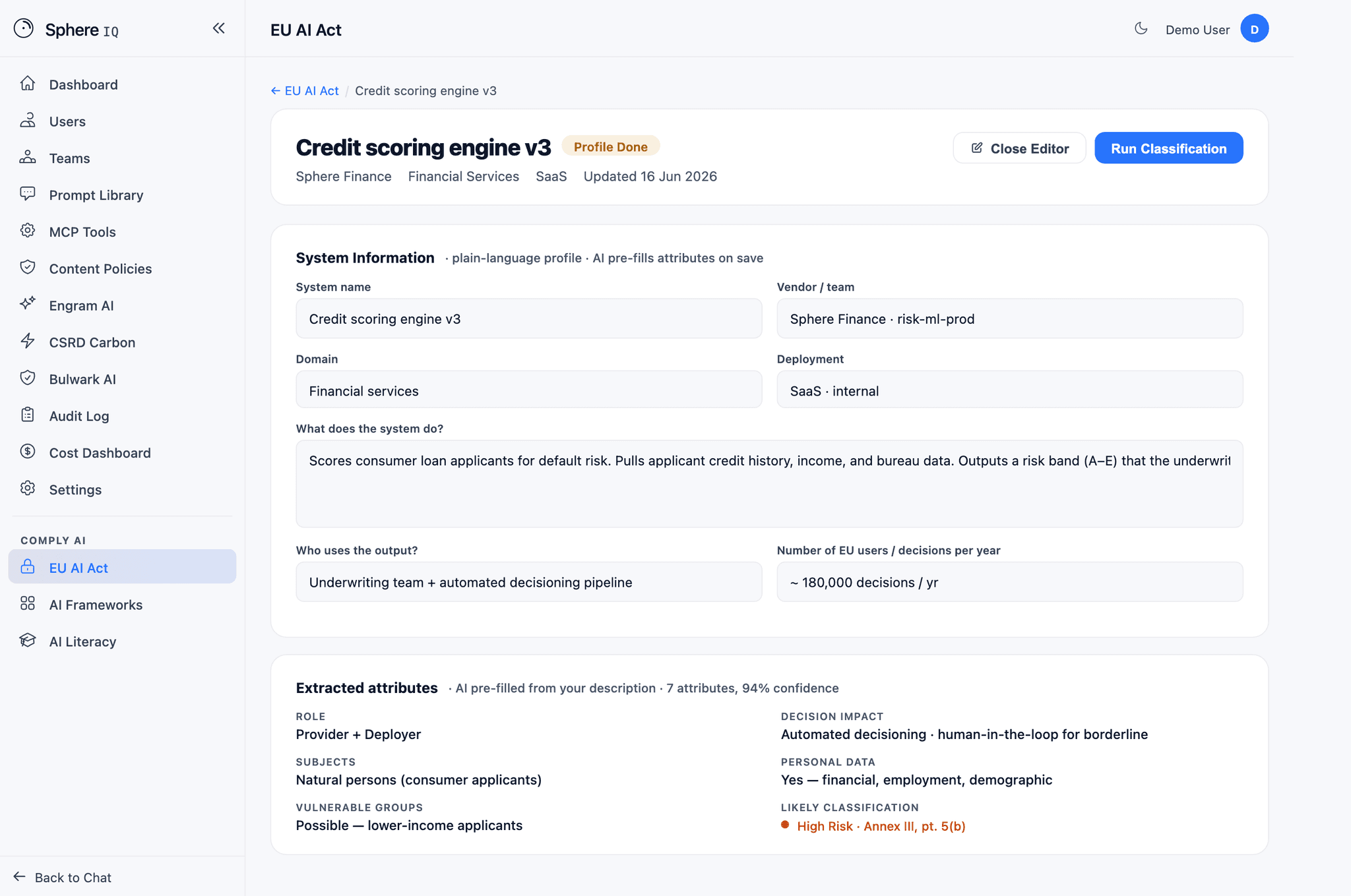
System intake and extracted attributes
Capture the intended purpose, affected users, data types, system owner, deployment context, and decision domain in one structured record.
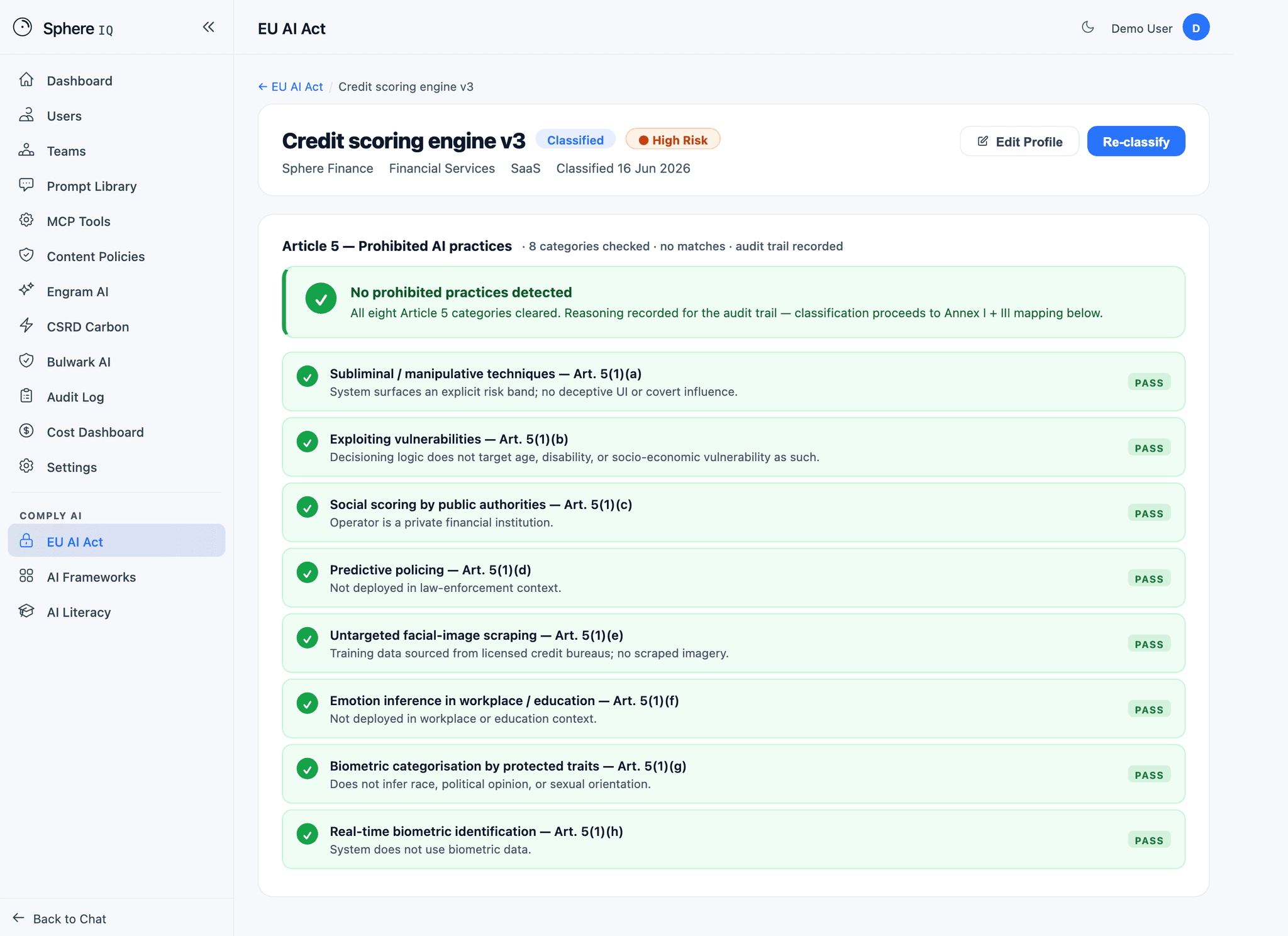
Risk classification with cited rationale
Show the risk level, supporting EU AI Act references, Article 5 screening result, Annex mapping, and plain-language explanation.
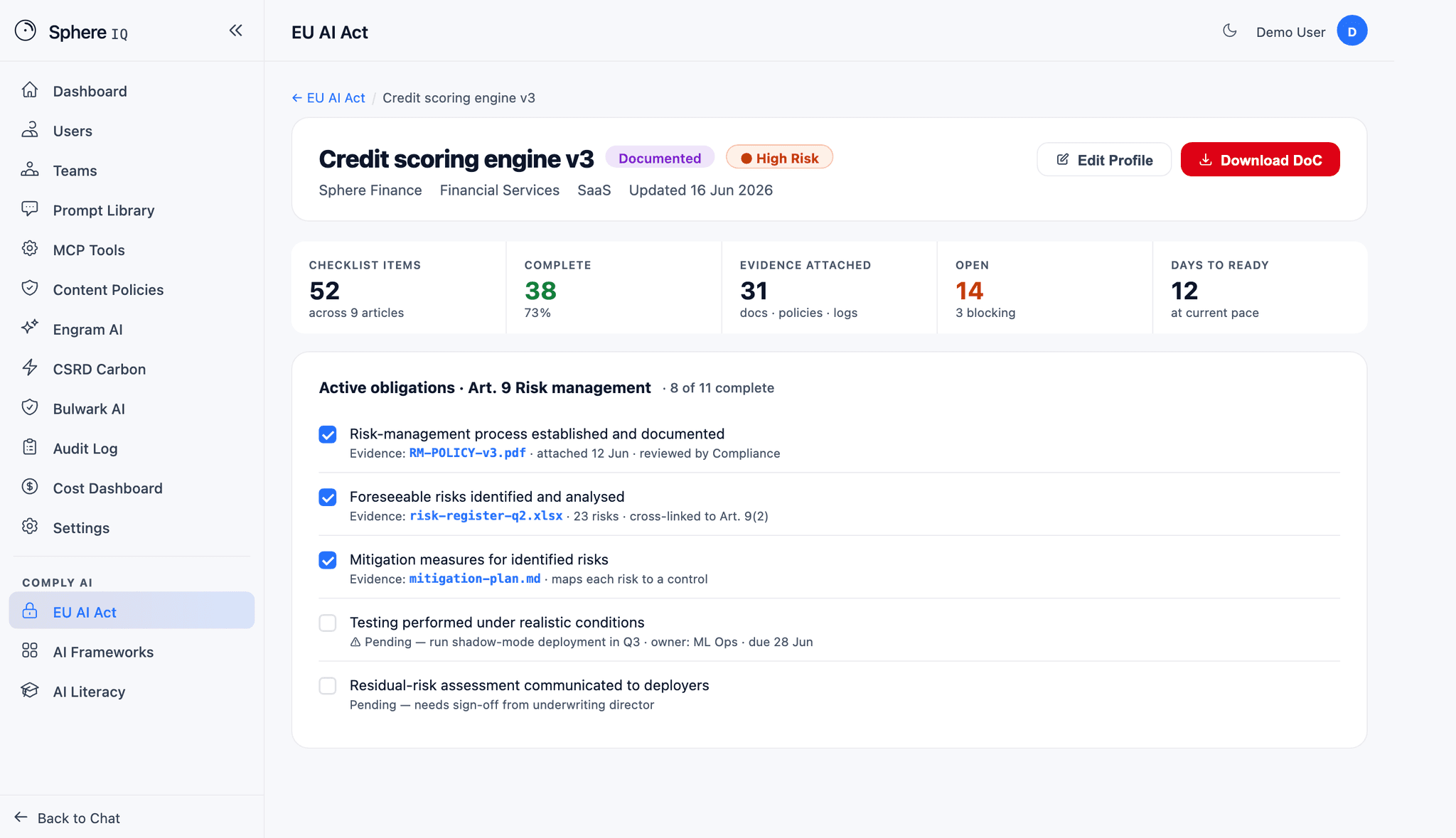
Conformity checklist and gap analysis
Turn classification into a prioritized action plan covering obligations, open gaps, evidence needs, owners, and next steps.
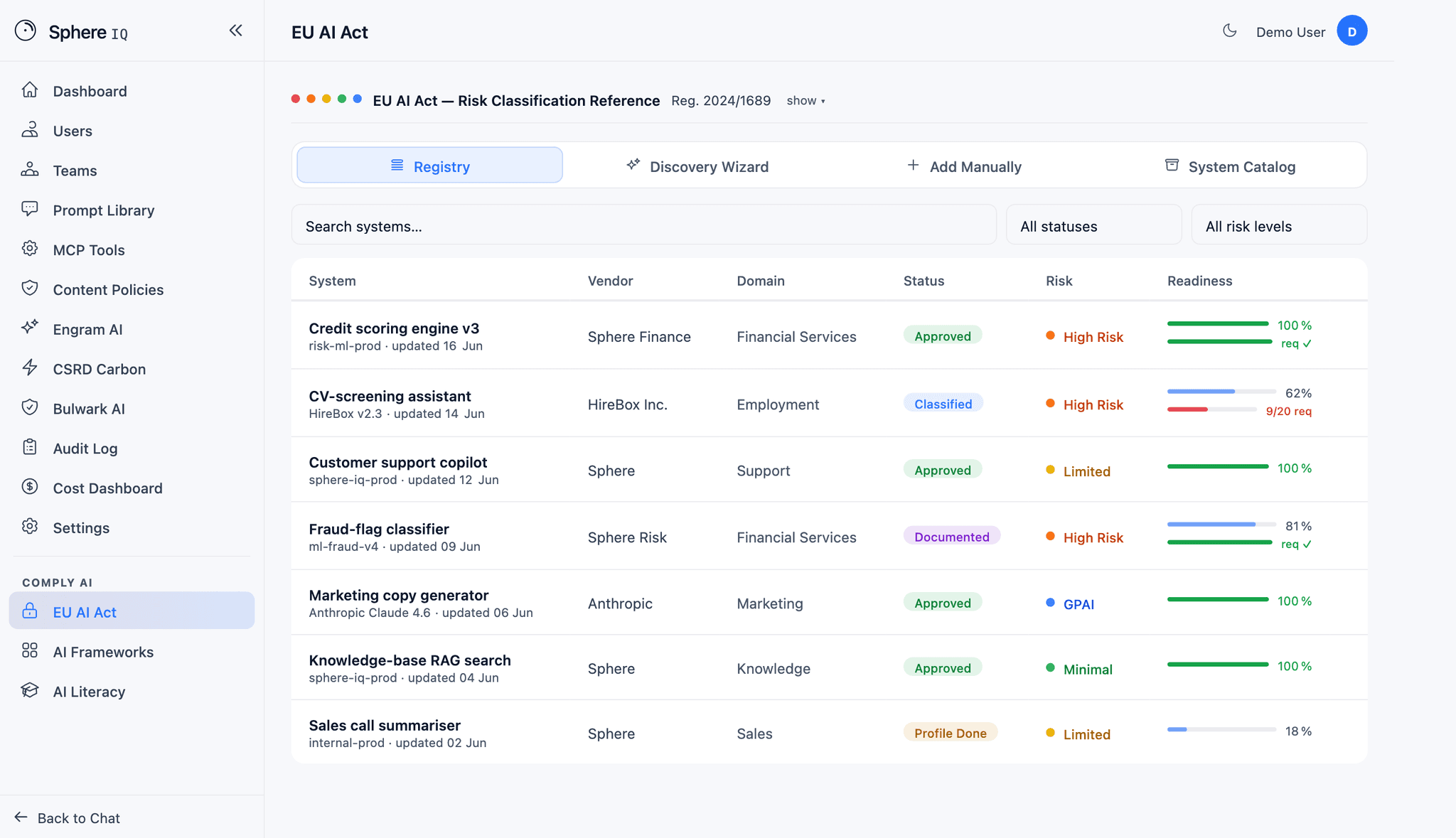
Living registry and audit trail
Maintain a searchable record of every AI system, classification status, owner, last review date, documentation package, and audit history.
Generate the evidence legal teams would otherwise assemble by hand.
Every report gives legal and compliance teams a structured first draft: classification rationale, obligations, gaps, owners, and evidence trail.
What the report contains
Comply AI produces the structural sections a national supervisory authority, Notified Body, audit committee, or legal team would expect to review.
- System identification and intended purpose
- Risk classification rationale with cited articles
- Data governance assessment under Article 10
- Technical documentation outline mapped to Annex IV
- Human oversight and record-keeping requirements
What happens next
The report is not the finish line. It gives teams a prioritized action plan for closing compliance gaps and maintaining records as the system changes.
- Accuracy, robustness, and cybersecurity obligations
- Post-market monitoring plan
- Gap analysis with priority ranking
- PDF export for internal or external review
- Legal team review and sign-off workflow
Maintain a living compliance record for every AI system.
A one-time wizard run is useful. A living registry is what keeps compliance work current as systems, data, purpose, and regulations change.
System registry
Every AI system, risk classification, owner, and conformity status in one searchable register.
Change tracking
When purpose, data, or deployment context changes, the system can be reclassified and the record updated.
Audit trail
Every classification, assessment, report, and version is timestamped and exportable.
Multi-regulation mapping
Map the same system against EU AI Act, NIST AI RMF, and ISO 42001 from one record.
Different leaders need different proof.
Comply AI gives each stakeholder a clear path from system review to documentation, evidence, and oversight.
"Which of our AI systems are high-risk?"
Classify multiple systems in one sitting and generate a board-ready summary of obligations and gaps.
"Our audit committee meets in three weeks."
Generate conformity packages, gap analyses, remediation plans, and owner assignments before the meeting.
"We need evidence of due diligence."
Maintain timestamped, signed, archived wizard runs that create a defensible record of AI system review.
Start with one AI system, then scale into a full registry.
Start with one system, review the classification package, and expand into a managed compliance record when the workflow is ready.
Live wizard walkthrough
Run one live AI system through classification, checklist generation, and gap analysis with a Comply AI specialist.
AI system inventory review
Classify a portfolio of AI systems and identify which systems need high-risk documentation or remediation.
SphereIQ Comply AI rollout
Implement the living registry, audit trail, multi-framework mapping, and ongoing governance workflow.
Sphere in Numbers
We understand that actions speak louder than words and numbers but here are some key facts about us.
Get the Right Talent now0
Years of Excellence
0+
Projects Delivered
0
Countries
Globally diverse, community-focused
0+
Clients
top 20 average 8+ years
Run the wizard on your AI system.
In 30 minutes, a Comply AI specialist will walk one of your live AI systems through the full classification, conformity checklist, and gap analysis.
What can we help you with?