



The first CSRD reporting software for AI emissions disclosure
CSRD Carbon tracks CO₂ per token, per model, and per team – then exports the quarterly ESRS E1 disclosure your sustainability report needs. 50,000+ EU companies are mandated to report Scope 3 AI emissions by 2026. Almost none have the data.

The data gap nobody talks about.
50,000+
EU companies required to file CSRD disclosures covering Scope 3 emissions, including those generated by IT services and AI workloads.
Zero
Major enterprise AI platforms today expose per-query, per-model carbon data in a format that maps to ESRS E1.
Q1 2026
First reporting period for the second wave of CSRD-mandated companies, with disclosures due in 2027.
Every query, measured at the token level
CSRD Carbon ties each interaction to a real emissions figure using three inputs. The result: a defensible Scope 3 figure for every conversation, every team, every quarter.
Token count
Every query consumes a measurable number of input and output tokens. SphereIQ logs these per user, per model, per workspace.
Model carbon intensity
Each LLM has a different emissions profile. GPT-4o, GPT-4o-mini, Claude Opus, Sonnet, Haiku, Llama, Mistral – each carries its own CO₂g per 1,000 tokens factor, updated quarterly from published research and provider disclosures.
Data centre energy mix
Where the inference happens matters. CSRD Carbon applies region-specific grid intensity factors (gCO₂/kWh) for every major cloud region. EU-West-1 (Ireland) is not the same as US-East-1 (Virginia).
Three views. One source of truth.
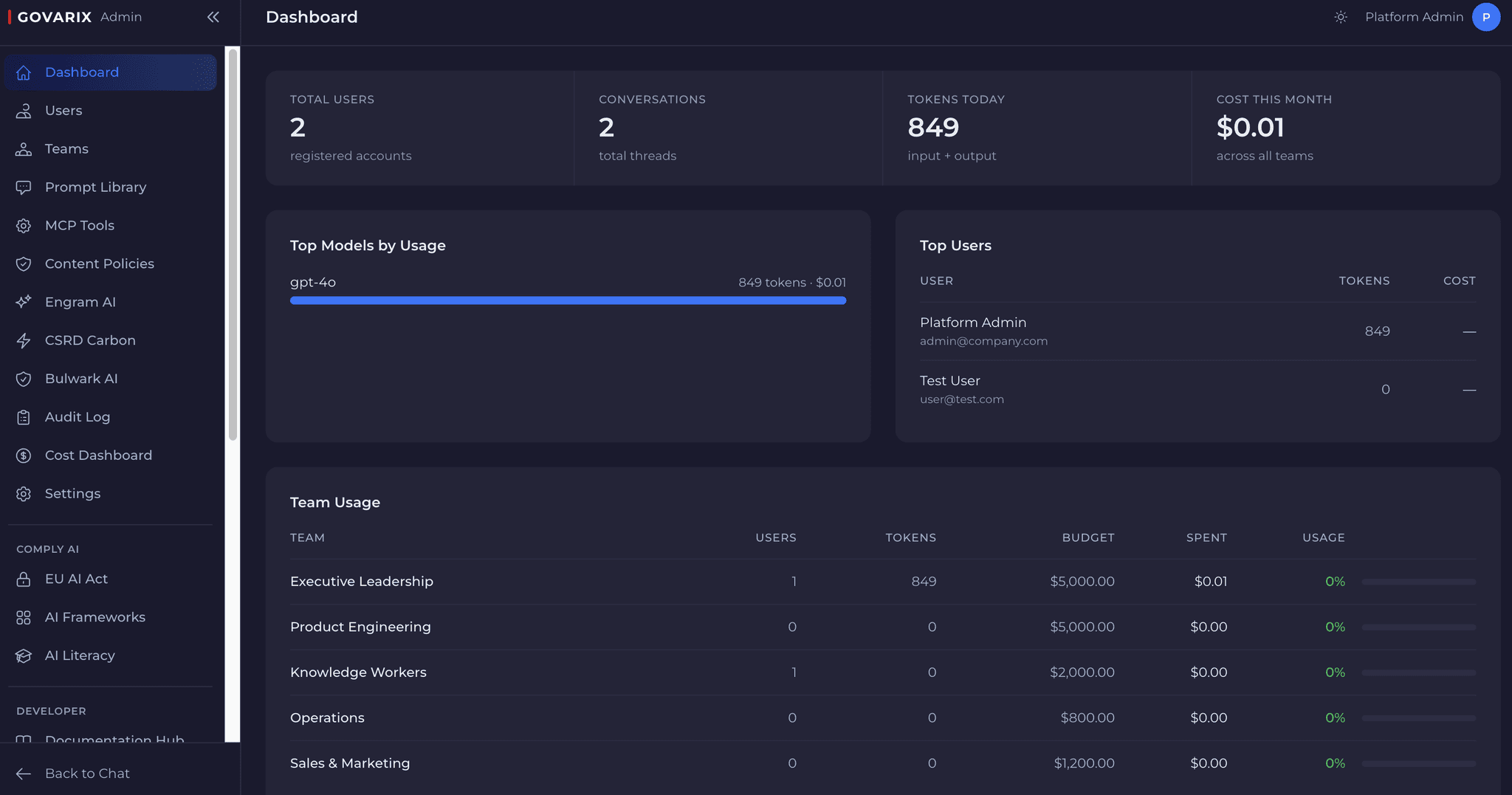
Executive dashboard
Quarterly emissions trend, year-on-year comparison, and the headline figure your CSRD report will quote. Filterable by entity, geography, and business unit.
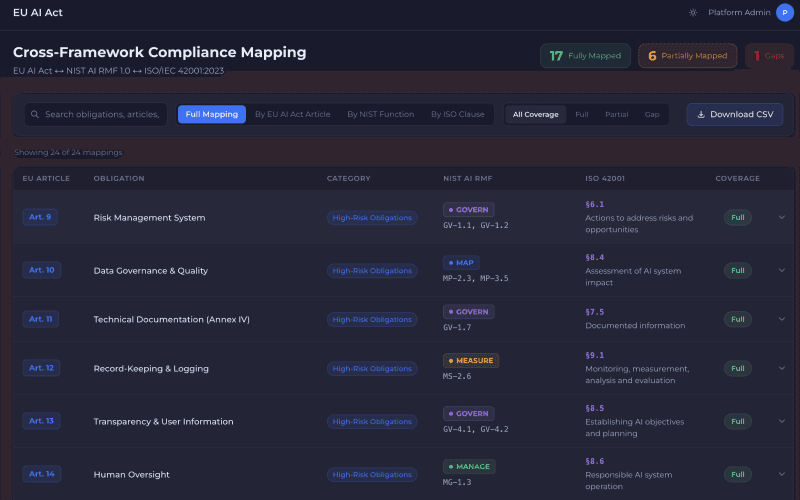
Operational dashboard
Real-time spend in euros alongside real-time emissions in grams. Token budgets and carbon budgets enforced together. Useful when the CFO and the CSO want the same screen.
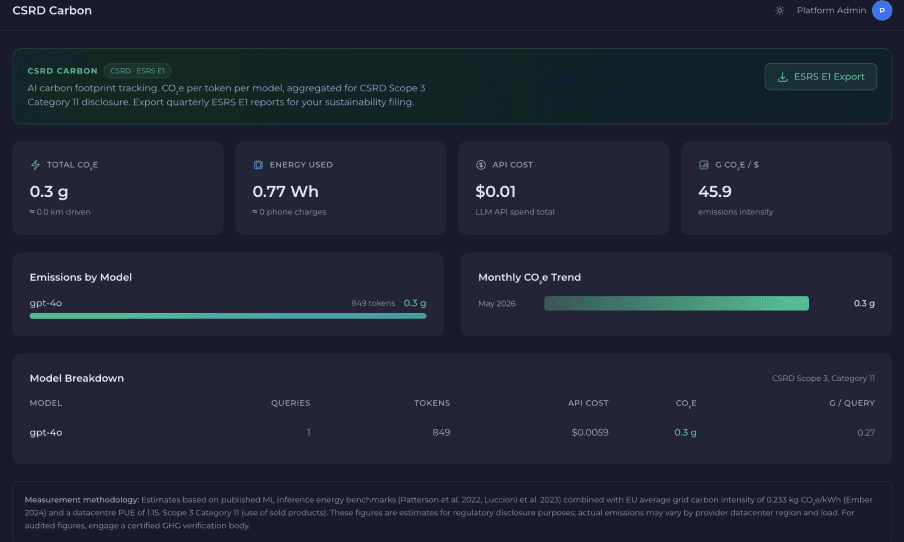
Model comparison
Same task, different model – which one emits less? CSRD Carbon makes the trade-off visible so teams can move workloads to lower-intensity models without losing quality.

One click. Audit-ready disclosure.
The quarterly export is structured against the European Sustainability Reporting Standard E1 – Climate Change. Your sustainability team takes the PDF, attaches it to the corporate disclosure, and the data lineage is documented.
- Total Scope 3 AI emissions for the period, with monthly breakdown
- Methodology statement describing token-counting, model factors, and grid intensity sources
- Per-entity breakdown matching the consolidated reporting boundary
- Per-model emissions table with confidence intervals
- Year-over-year comparison once historical data exists
- Auditor support package – raw token logs, model factor sources, grid data citations
Get the CSRD AI Emissions Disclosure Template
A 16-page reference document with the structure, methodology language, and worked examples your sustainability team can adapt for your first ESRS E1 filing.
Three roles, three reasons to look at this dashboard
Our auditor asked where the AI emissions number comes from. I need a defensible methodology.
CSRD Carbon's documented token-counting, model-factor sourcing, and grid intensity citations are the methodology.
Head of Sustainability
The CSRD report is a board-level filing. I need the AI emissions figure to reconcile with the IT spend figure.
The same dashboard shows euros and grams, drawn from the same usage data. Reconciliation is one query.
CFO
The sustainability team is asking me for AI emissions data. I don't have it.
CSRD Carbon is the data source. The sustainability team self-serves; IT stops being a bottleneck.
Head of IT
Sphere in Numbers
We understand that actions speak louder than words and numbers but here are some key facts about us.
Get the Right Talent now0
Years of Excellence
0+
Projects Delivered
0
Countries
Globally diverse, community-focused
0+
Clients
top 20 average 8+ years
We'd love to hear from you!
Please provide your contact details, and our team will get back to you promptly.