


OpenClaw Alternatives: The Enterprise Evaluation Guide (2026)
Thirteen alternatives, compared the way a CISO would compare them — by blast radius, credential handling, and operational burden. Not by feature count.
- Anton ShemereyField CTO
Somewhere on your network, right now, there is probably an OpenClaw instance you didn't approve. It has your employee's email, their calendar, their Slack — and if they connected work accounts, it has OAuth tokens that move laterally. OpenClaw earned its 375,000+ GitHub stars: it is the most capable open-source personal AI agent ever shipped. But 2026 also made it the poster child for what happens when capability outruns governance — a critical one-click remote code execution flaw, over 135,000 internet-exposed instances across 82 countries, and a skill marketplace where roughly one in five packages was malicious at peak.
This guide compares the alternatives the way we advise Sphere's enterprise clients to compare them: by risk model, not feature list. The market has segmented into five distinct lanes, and the right choice depends on a question most listicles never ask — what's the blast radius if this goes wrong?
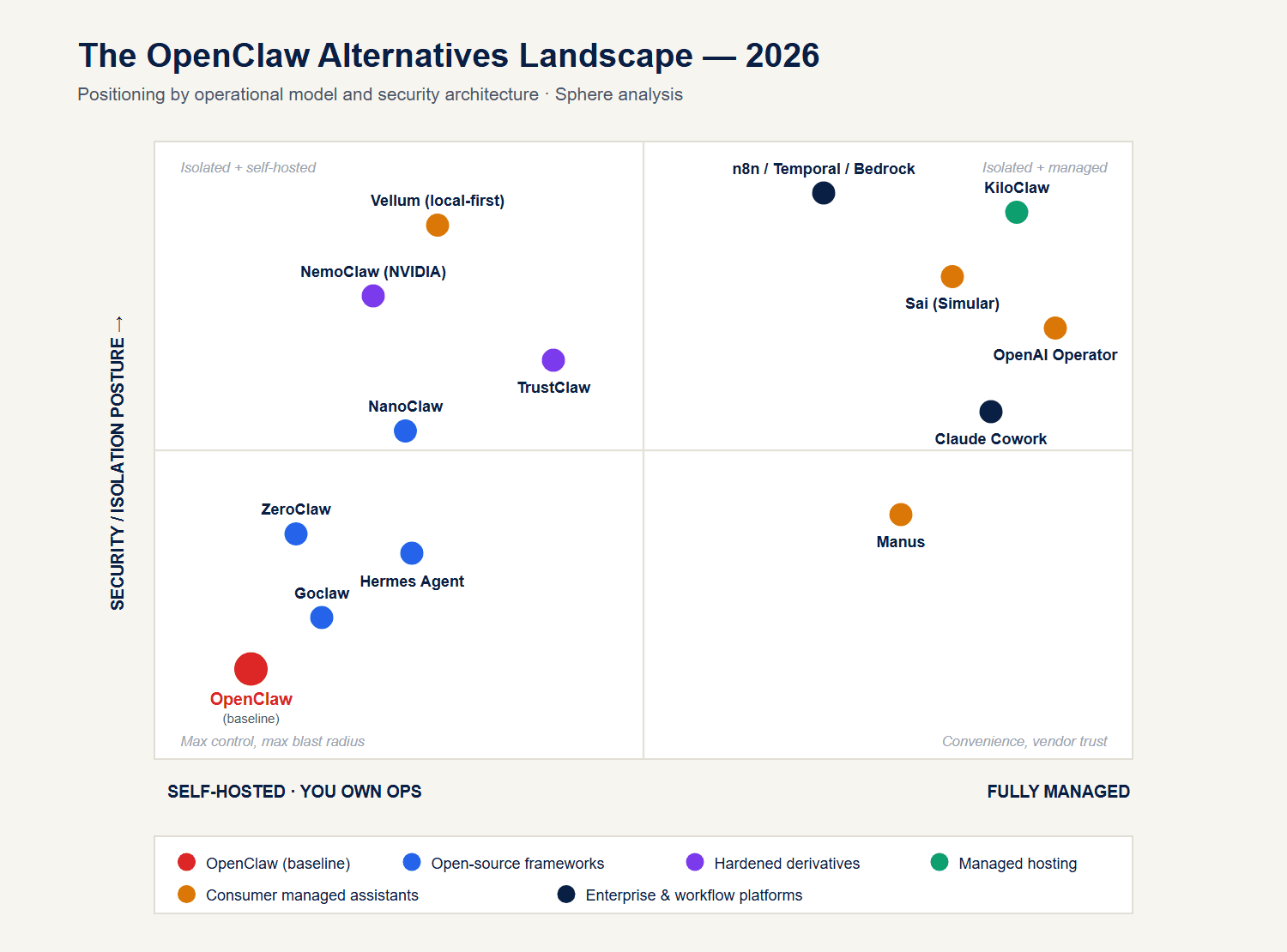
Two very different bets in open source
Anton's framing is the practical heart of this guide: within the open-source tier, the real differentiator is workload shape, not feature count. ZeroClaw's value concentrates at the edge — constrained devices and IoT fleets where a tiny, dependency-free binary matters more than ecosystem breadth. Hermes' value concentrates in the human working day — a single-agent daily driver whose memory engine and self-learning loop compound in usefulness the longer it runs. The question isn't "which is better." It's "is the workload a device fleet, or a person?"
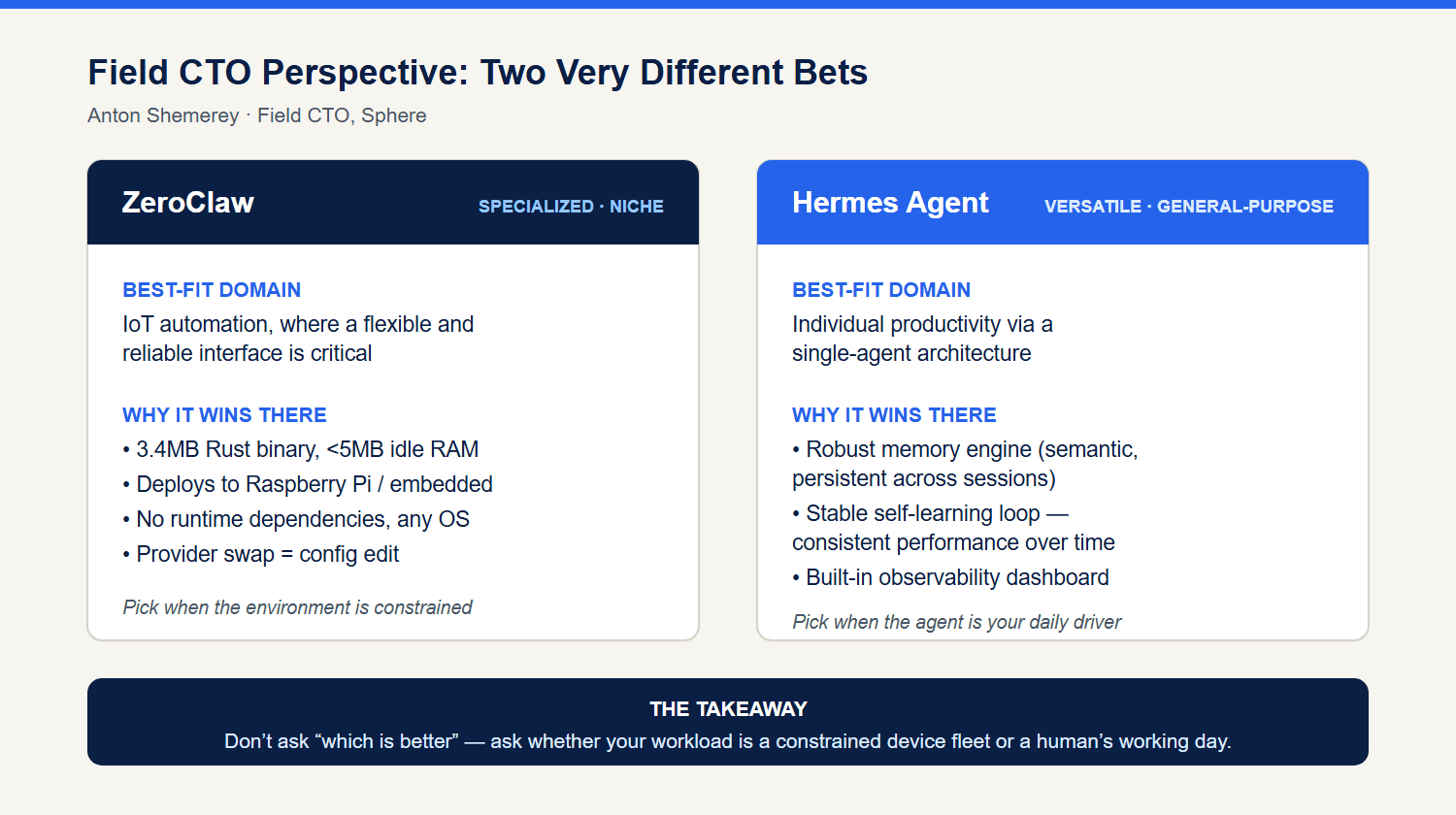
Why are people looking for OpenClaw alternatives?
OpenClaw's dominance is real. So are four structural weaknesses that created this market:
- Security architecture. An operator-trust model with broad credential access by design; prompt injection is explicitly scoped out of security fixes. 2026 brought CVE-2026-25253 (a one-click RCE, CVSS 8.8), the ClawJacked browser-hijack class, 135,000+ internet-exposed instances, and the ClawHavoc supply-chain campaign — roughly 1,184 malicious skills, about one in five ClawHub packages at peak.
- Operational burden. Self-hosting means VPSs, Docker, Node 24, OAuth debugging, and patch churn — every week, indefinitely.
- Cost unpredictability. Always-on agentic workloads burn frontier-model tokens fast.
- Governance gaps. No centralized enterprise kill switch, flat-file memory, no tenant isolation. China restricted state agencies from running it.
Category 01 · Open Source
Lean, self-hosted replacements
Hermes Agent
Verdict: best open-source pick for memory, observability, and model/cost control
The closest philosophical peer to OpenClaw — self-hosted and MIT-licensed, but leaner and more transparent. It replaces OpenClaw's flat-file memory with a ChromaDB-backed semantic layer, adds a local dashboard for sessions, logs, and cron jobs, and supports any OpenAI-compatible endpoint so teams can route to open-weight models for cost control.
Pros
- •Persistent semantic memory
- •Built-in observability
- •Model/cost flexibility
- •Free (MIT)
Cons
- •ChromaDB adds deployment complexity
- •Smaller skill ecosystem
- •You still own ops and security
ZeroClaw
Verdict: best for IoT, edge, and constrained hardware
A minimal, Rust-based agent — a 3.4 MB binary with sub-10 ms startup and under 5 MB idle RAM, deployable to a Raspberry Pi, embedded hardware, or a $4/month VPS. Roughly 30K GitHub stars since its February 2026 release. Provider changes are a config edit, not a code change.
Pros
- •Extreme efficiency and portability
- •No runtime dependencies
- •Provider-agnostic
Cons
- •Early-stage, thin ecosystem
- •CLI-first, developer-only
- •Security remains your job
NanoClaw and Goclaw
NanoClaw containerizes every agent run by default — a smaller blast radius by architecture rather than policy, with setup comparable to OpenClaw's five-minute install. Goclaw is an OpenClaw-compatible reimplementation in Go: faster runtime characteristics and skill portability, but it inherits OpenClaw's security assumptions and has a niche community.
Category 02 · Hardened Derivatives
OpenClaw's engine, wrapped in real isolation
NemoClaw (NVIDIA)
Verdict: best self-hosted option that survives a security review
NVIDIA's production reference stack for OpenClaw, announced March 16, 2026. Onboarding builds an isolated container for the OpenClaw runtime and routes all inference through OpenShell's managed proxy — agent code never touches your network interface directly. Compliance teams get auditable architecture instead of a policy document; the trade-off is a heavier stack and a short operational track record.
TrustClaw
A security-hardened OpenClaw fork with additional policy controls and audit logging, positioned between raw OpenClaw and the full NVIDIA reference stack. Better suited for teams that need compliance controls without the full managed proxy overhead.
Category 03 · Managed Hosting
Same capabilities, zero ops
KiloClaw
Verdict: best for always-on OpenClaw agents without infrastructure
Hosted, production-ready OpenClaw running in under two minutes — five-layer tenant isolation with Firecracker VM boundaries, AES-256 encrypted credential vaults, tool allow-lists, and 500+ models via gateway with BYOK. Notably, it's the only alternative with published third-party validation: a 10-day PASTA-framework assessment in February 2026 ran 60+ adversarial tests and found zero cross-tenant vulnerabilities. The trade: you exchange self-hosted data sovereignty for a vendor relationship.
Category 04 · Managed Consumer
A different paradigm: safety through constraint
Sai by Simular — a native desktop app from ex-DeepMind engineers — executes tasks in an isolated cloud VM with approval gates before critical actions, and posted the fastest time-to-first-task in comparative testing. Vellum is the privacy outlier: local-first with credential isolation so secrets never reach the model. Manus handles long autonomous workflows as a Meta cloud service — the opposite privacy posture from self-hosting. OpenAI Operator is deliberately browser-only: a much smaller attack surface, bought with a hard capability ceiling.
Category 05 · Enterprise
When the workload can't tolerate mistakes
Claude Cowork brings autonomous desktop automation — file access, scheduled tasks, computer use — inside a managed product's guardrails rather than an open framework's operator-trust model. And for payroll, finance, or compliance workloads, deterministic workflow platforms — n8n, Temporal, AWS Bedrock Agents — replace probabilistic loops with auditable trigger → condition → action → log chains. A loop that succeeds nine times out of ten is impressive in a notebook and unacceptable in a payroll run.
How do the OpenClaw alternatives compare?
| Alternative | Type | Security vs. OpenClaw | Self-host | Memory | Best for | Biggest drawback |
|---|---|---|---|---|---|---|
| OpenClaw (baseline) | OSS framework | Operator-trust, full local access | Yes | Flat files | Max capability + community | Security architecture, ops burden |
| Hermes Agent | OSS framework | Similar, more transparent | Yes | Semantic (ChromaDB) | Memory + observability | ChromaDB complexity |
| ZeroClaw | OSS framework (Rust) | Similar, tiny surface | Yes | Config-driven | IoT/edge, constrained hardware | Young, thin ecosystem |
| NanoClaw | OSS framework | Container isolation by default | Yes | Basic | Isolation-minded self-hosters | Fewer integrations |
| NemoClaw (NVIDIA) | Hardened (NVIDIA) | OS-level sandbox + proxy | Yes | Inherits OpenClaw | Compliance-reviewed production | Heavier stack, new |
| KiloClaw | Managed hosting | Firecracker VMs, credential vault | No | Inherits OpenClaw | Always-on agents, zero ops | Vendor dependency |
| Sai (Simular) | Managed consumer | Cloud VM + approval gates | No | Managed | Non-technical users | Limited customization |
| Vellum | Local-first consumer | Secrets never reach the model | Partial | Months-long | Privacy-first Mac users | Mac-centric |
| Manus | Cloud consumer | Meta cloud | No | Managed | Long autonomous workflows | Data practices |
| OpenAI Operator | Cloud consumer | Browser sandbox only | No | Session | Low-risk web tasks | Capability ceiling |
| Claude Cowork | Enterprise product | Managed guardrails | No | Managed | Anthropic-ecosystem desktop automation | Single ecosystem |
| n8n / Temporal / Bedrock | Workflow platform | Deterministic, IAM-governed | Varies | Workflow state | Mistake-intolerant workloads | Not a personal assistant |
Which OpenClaw alternative should you choose?
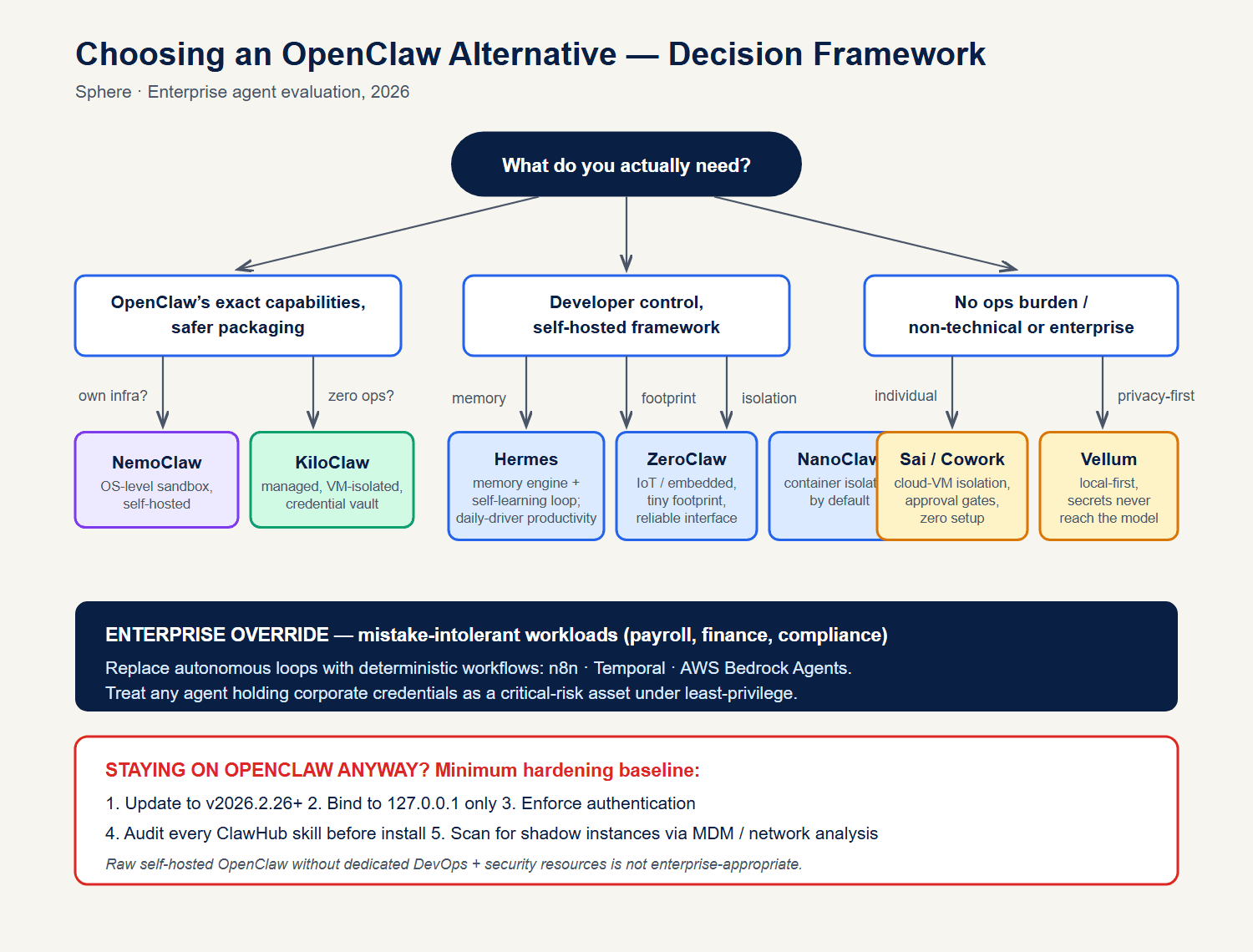
The decision depends on one question asked before any feature comparison: what's the blast radius if this goes wrong?
- Need OpenClaw's exact capabilities, self-hosted? → NemoClaw (OS-level sandbox) or NanoClaw (container isolation by default).
- Need OpenClaw's capabilities with zero ops? → KiloClaw (managed, Firecracker VM-isolated, credential vault, third-party validated).
- Developer daily driver — memory and observability? → Hermes Agent (semantic memory engine + self-learning loop).
- IoT or constrained hardware? → ZeroClaw (3.4 MB Rust binary, no runtime dependencies, provider-agnostic).
- Non-technical users or privacy-first? → Sai by Simular (cloud VM + approval gates) or Vellum (local-first, secrets never reach the model).
- Payroll, finance, or compliance workloads? → n8n, Temporal, or AWS Bedrock Agents. Replace autonomous loops with deterministic auditable workflows.
If staying on OpenClaw: minimum hardening baseline — update to v2026.2.26+, bind to 127.0.0.1 only, enforce authentication, audit every ClawHub skill before install, and scan for shadow instances via MDM or network analysis.
The market is segmenting by risk model, not features
OpenClaw won the mindshare war and remains the default for developers who want maximum capability and community. But its operator-trust security model, marketplace supply-chain exposure, and ops burden opened legitimate lanes: hardened derivatives, managed hosting, lean frameworks, safer consumer products, and deterministic enterprise platforms. The winning evaluation question in 2026 isn't "what can it do?" — it's "what's the blast radius if this goes wrong?"
For the underlying criteria we use to score any autonomous agent — not just OpenClaw's lineage — see our companion piece, How to Evaluate AI Agents in 2026.
Frequently asked questions
What are the best alternatives to OpenClaw in 2026?▾
The strongest OpenClaw alternatives are Hermes Agent and ZeroClaw (lean open-source frameworks), NemoClaw (NVIDIA's sandboxed derivative), KiloClaw (managed hosting with VM isolation), Sai by Simular and Claude Cowork (managed assistants), and deterministic workflow platforms like n8n and Temporal for mistake-intolerant enterprise workloads.
Is OpenClaw safe for business use?▾
Raw self-hosted OpenClaw is not enterprise-appropriate without dedicated DevOps and security resources. Its operator-trust model grants the agent broad credential access, prompt injection is scoped out of security fixes, and 2026 incidents included a critical one-click RCE (CVE-2026-25253), 135,000+ exposed instances, and roughly 1,184 malicious skills on ClawHub.
What is the safest OpenClaw alternative?▾
For self-hosting, NemoClaw adds OS-level sandboxing and routes inference through a managed proxy. For zero-ops deployments, KiloClaw runs OpenClaw inside Firecracker VM boundaries with encrypted credential vaults and published third-party security validation. For individuals, Sai by Simular executes tasks in an isolated cloud VM with approval gates.
How much does OpenClaw cost to run?▾
The software is free (MIT license), but always-on agentic use consumes large token volumes on frontier models, plus VPS or dedicated hardware costs. Teams control costs by routing to open-weight models — lightweight workloads can run from roughly $0.10 per million input tokens on hosted open models plus a $5–10/month VPS.
Should enterprises allow employees to run OpenClaw?▾
Not without governance. Any OpenClaw instance holding corporate credentials should be treated as a critical-risk asset: enforce least-privilege, require v2026.2.26+, bind to localhost only, mandate authentication, audit every installed skill, and scan for shadow instances via MDM or network analysis.