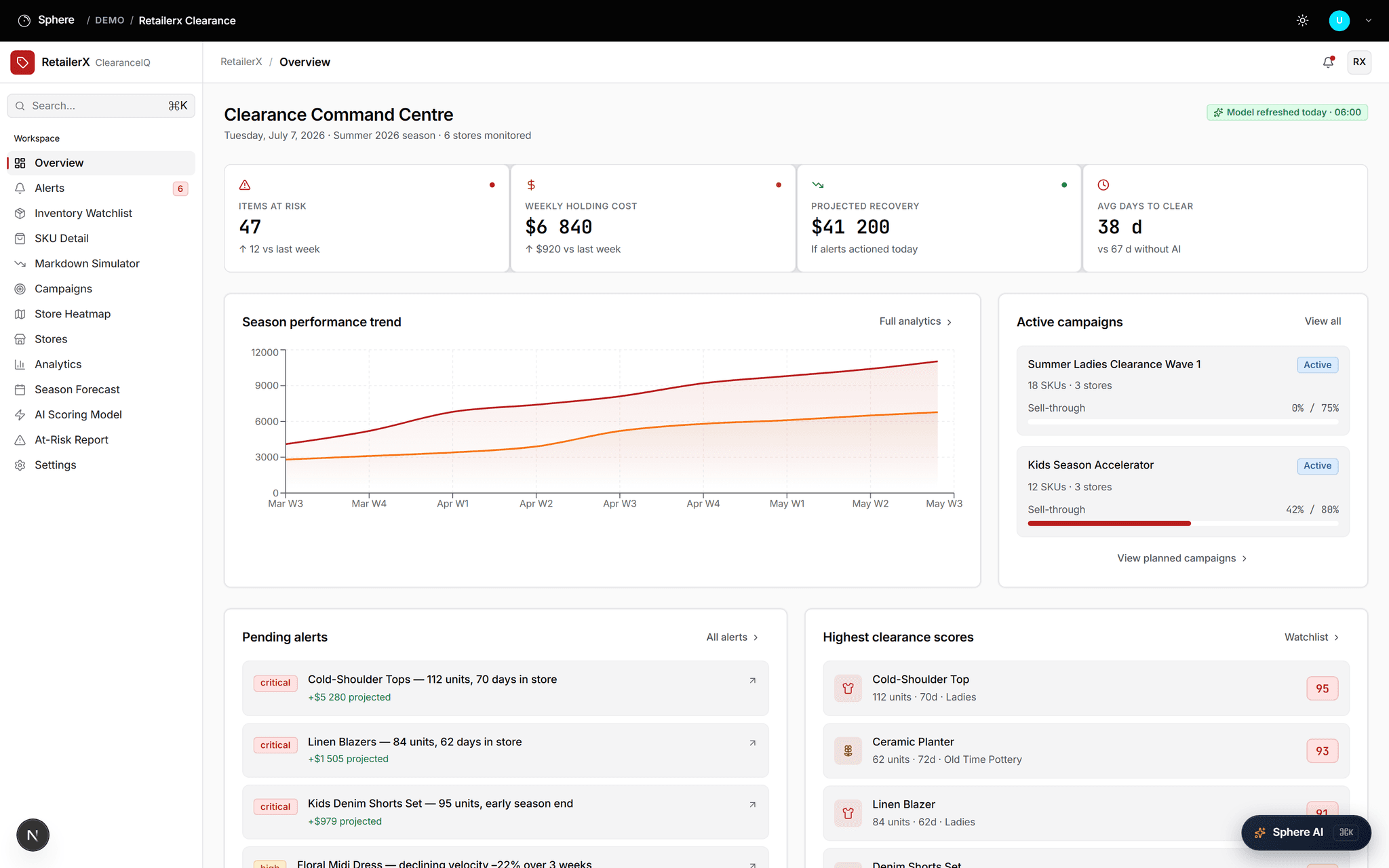
Case Study • AI Store Operations
One of our GMs got 142 minutes back—without adding headcount
- Client
- National off-price retailer
- Industry
- Off-Price Retail
- Service
- AI Solutions|Data Analytics
Overview
Sphere built the Operations Bureau for a national off-price retailer. Two always-on AI desks—one on the sales floor and one in the back office—clear routine decisions before they reach a general manager’s desk.
How do routine store exceptions consume GM time?
A general manager has to resolve staffing, delivery, and invoice exceptions in the same hour. When all three compete for attention, the paperwork quietly loses money.
Tomorrow’s truck is 42% over plan
Discovered at 06:00, it is already too late to add receiving coverage.
A paper invoice has a two-case gap
It gets paid as billed or waits for a monthly audit that may never happen.
Weather changes the weekend
The impact appears later as an unexplained swing in the comp report.
Our Solution
The Operations Bureau watches the floor and back office continuously, performs the analysis, and asks the GM only for decisions that genuinely require a signature.
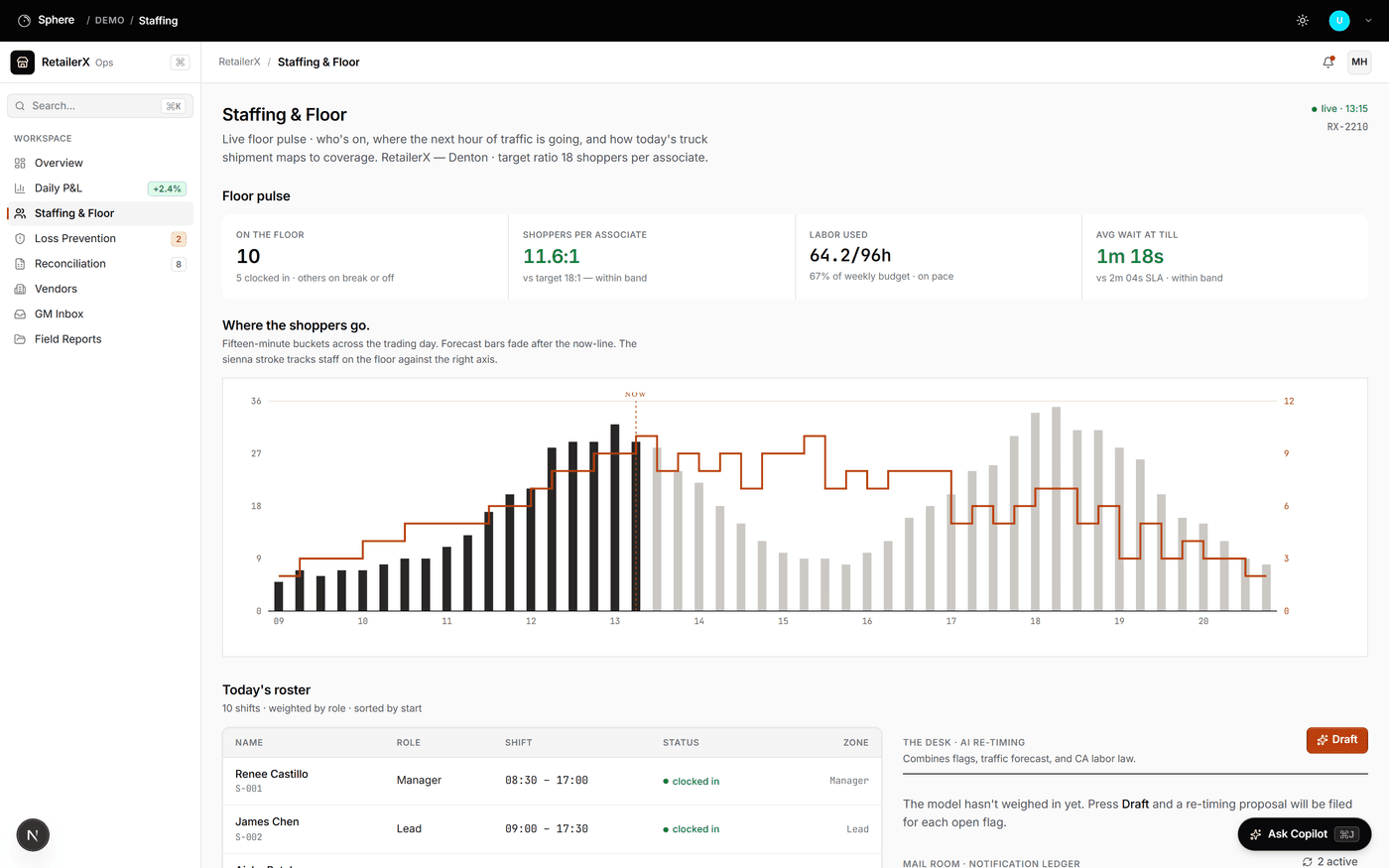
1. Staff the delivery against real volume
For a 1,180-unit delivery planned at 830 units, the desk recommended adding two receivers from 05:45 to 09:30 and moving one floor associate to 11:00. The $87 labor change protected an estimated $620 in sell-through by getting apparel onto the floor before the morning peak ended.
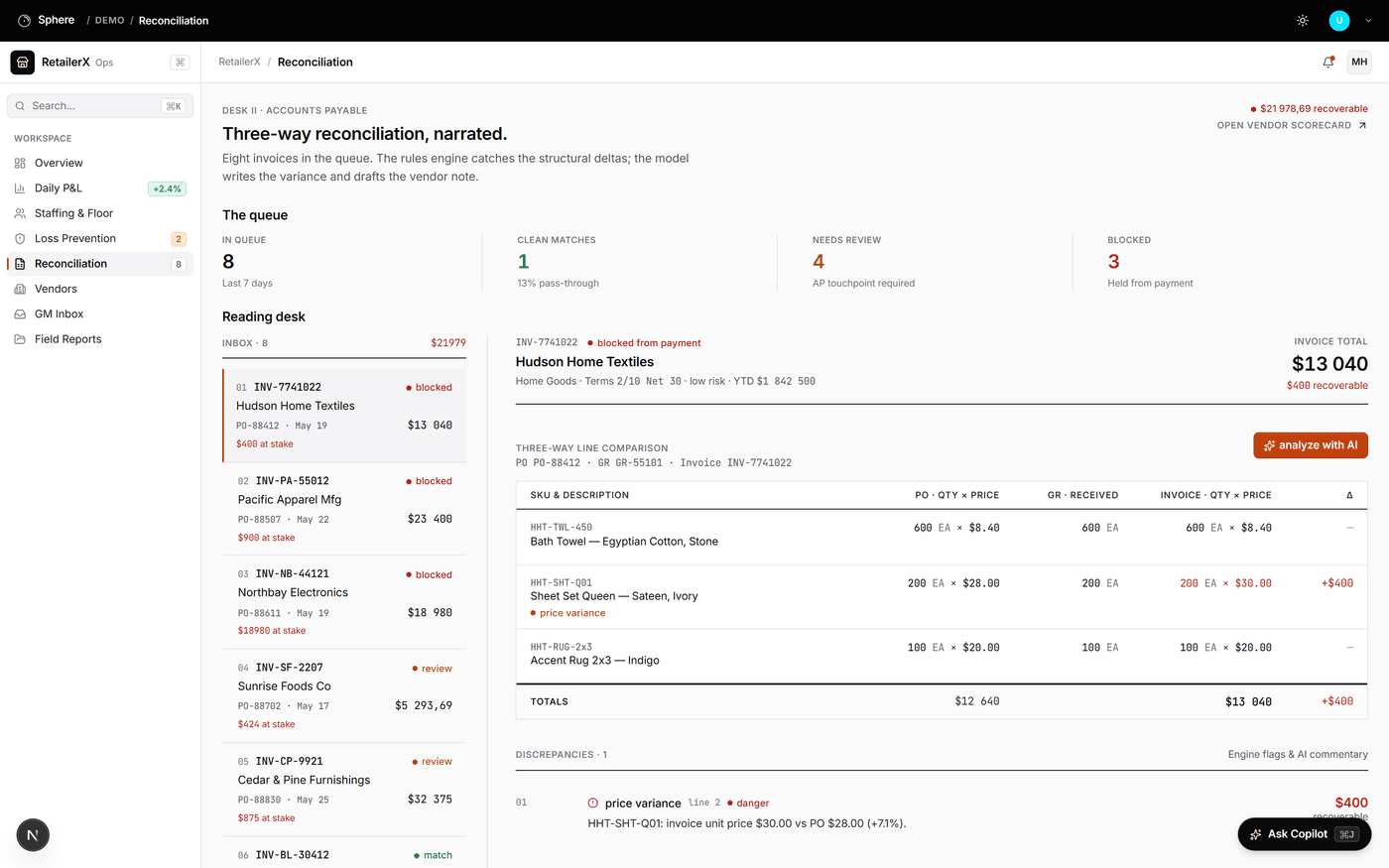
2. Reconcile only the exception
When a vendor invoiced 14 cases but the receiver scanned 12, the desk matched the 12 correct cases and routed only the $284 delta with photo evidence. It also recognized the third discrepancy that week—$1,840 total—and escalated the vendor pattern to AP.
Key Achievements
Margin recovered from vendors
DSD and AP leakage is recovered without a promotion or customer price change.
Labor follows real volume
Staffing responds to delivery size, traffic, and weather rather than a fixed template.
Leadership returns to the floor
Eleven GM hours a week are redirected from paperwork to coaching and customers.
Every decision has an audit trail
Automated matches, flags, evidence, and recovered dollars remain documented.
The model scales without matching headcount
The same two desks run across the fleet and compound by store count.
Results
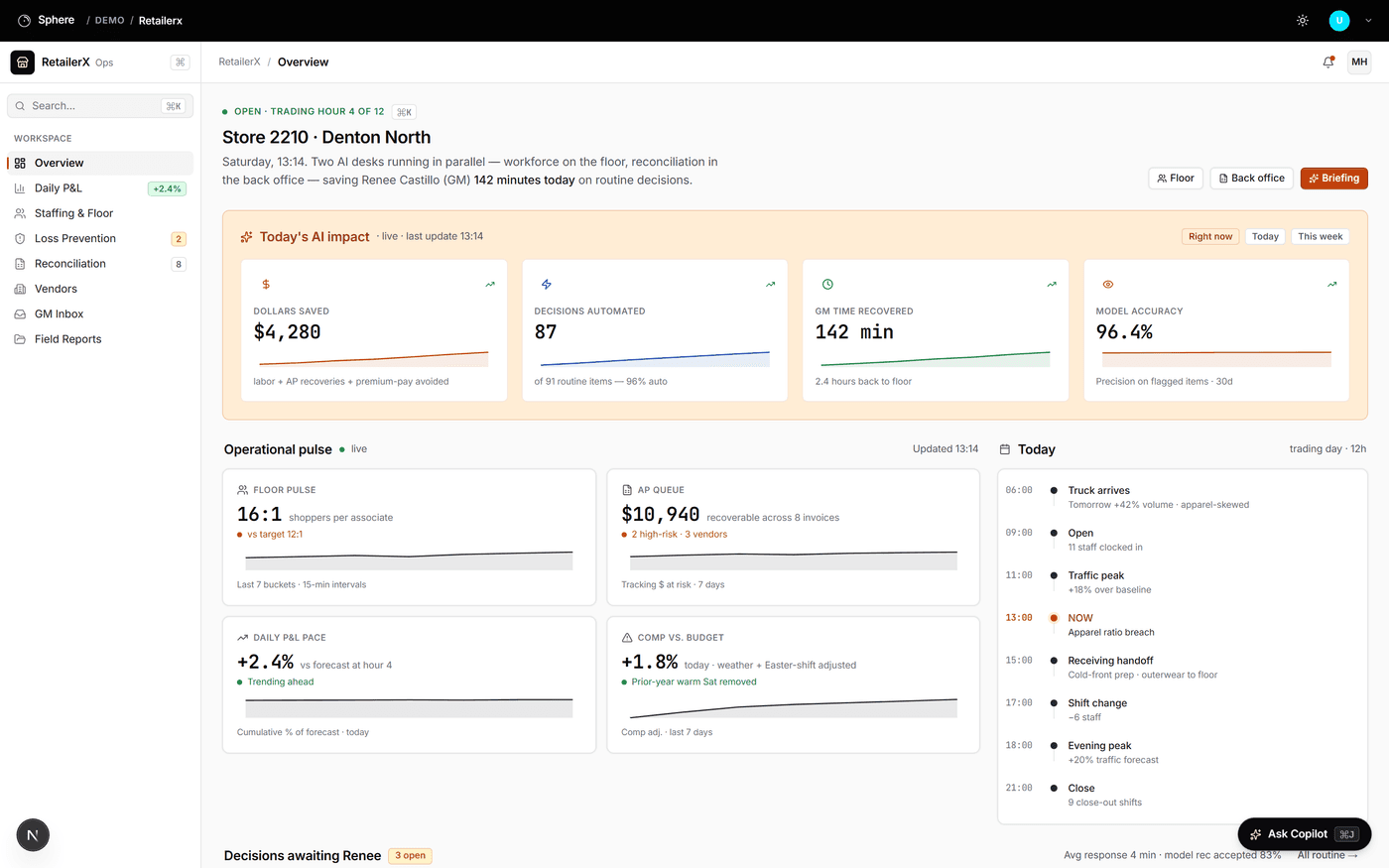
Four hours into the representative shift, 87 of 91 routine decisions had cleared without GM intervention, $4,280 had been saved or recovered, and 142 minutes were returned to store leadership.
Over 12 months, the two desks are modeled to recover $32,400 in DSD shrink per store, recover $184,000 from AP variances, reduce labor cost by 4.2% at unchanged floor coverage, and return 11 GM hours each week. Figures are modeled output from Sphere’s anonymized RetailerX build, not disclosed production financials.